CNC sheet metal fabrication is not only about cutting an accurate flat profile. If the finished component requires bends, the design also needs to account for how the material will move, stretch and compress during forming. Bend radius, material thickness, hole placement, bend sequence and tooling access can all influence whether the finished part matches the intended dimensions.
Thinking about these factors early can make a design easier to manufacture and reduce unnecessary changes once production begins. This is particularly important for high-precision sheet metal parts, where several cut, punched and formed features may need to align correctly after bending.
A practical design therefore considers cutting and bending as connected stages rather than treating the flat pattern and finished component as separate problems.
CNC Sheet Metal Fabrication: Plan Bends Before Cutting
CNC sheet metal fabrication should consider bend locations before the final cutting file is approved.
When sheet metal is bent, the material does not simply fold along a perfectly sharp line. The outside of the bend is placed under tension while the inside is compressed. The finished geometry therefore depends on the bend radius, material thickness and forming method.
This is why bend information should form part of the design rather than being left for the workshop to interpret after the flat profile has already been cut.
A component may look straightforward in its flat state but become difficult to form when several bends interact.
Flanges may collide with tooling. A bend may prevent access to another part of the component. A hole that appears correctly positioned in the flat pattern may distort when the nearby material is formed.
For CNC sheet metal fabrication, reviewing these issues before cutting can help determine whether the part needs a different bend position, flange length or manufacturing sequence.
The drawing should clearly communicate the finished dimensions and required angles so the fabricator understands the intended result rather than having to infer it from the flat profile alone.
CNC Sheet Metal Fabrication: Keep the Final Shape Practical
CNC sheet metal fabrication works more smoothly when the finished geometry can actually be produced with available forming equipment.
Complexity is not necessarily a problem, but each additional bend can change how the component is handled.
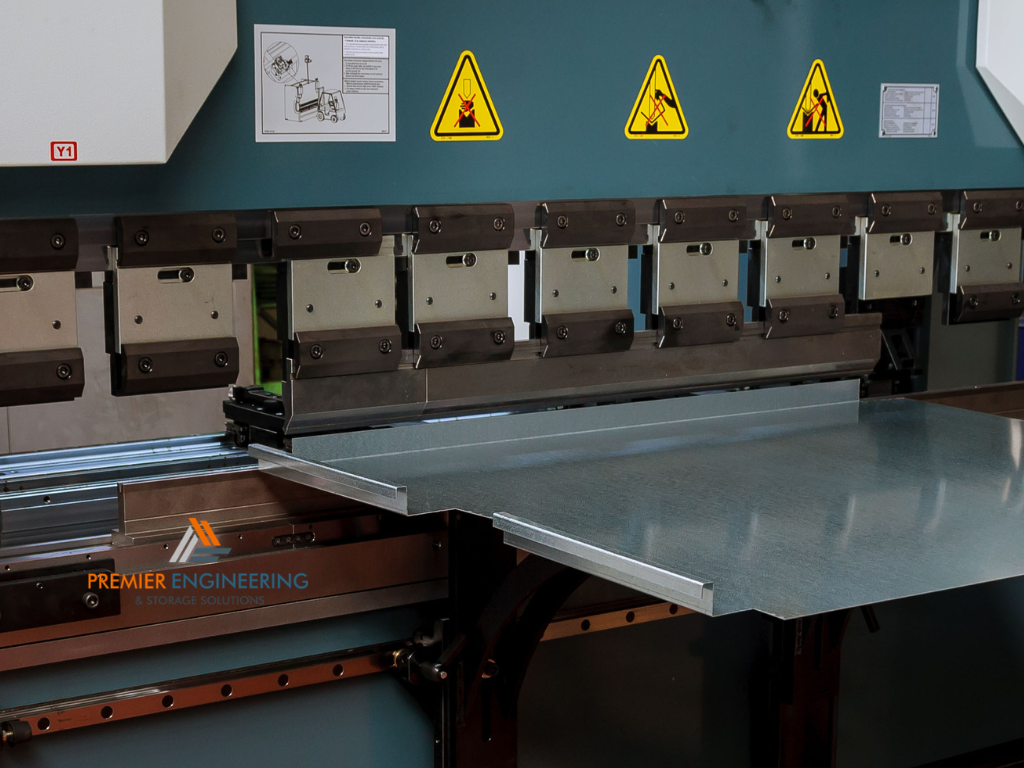
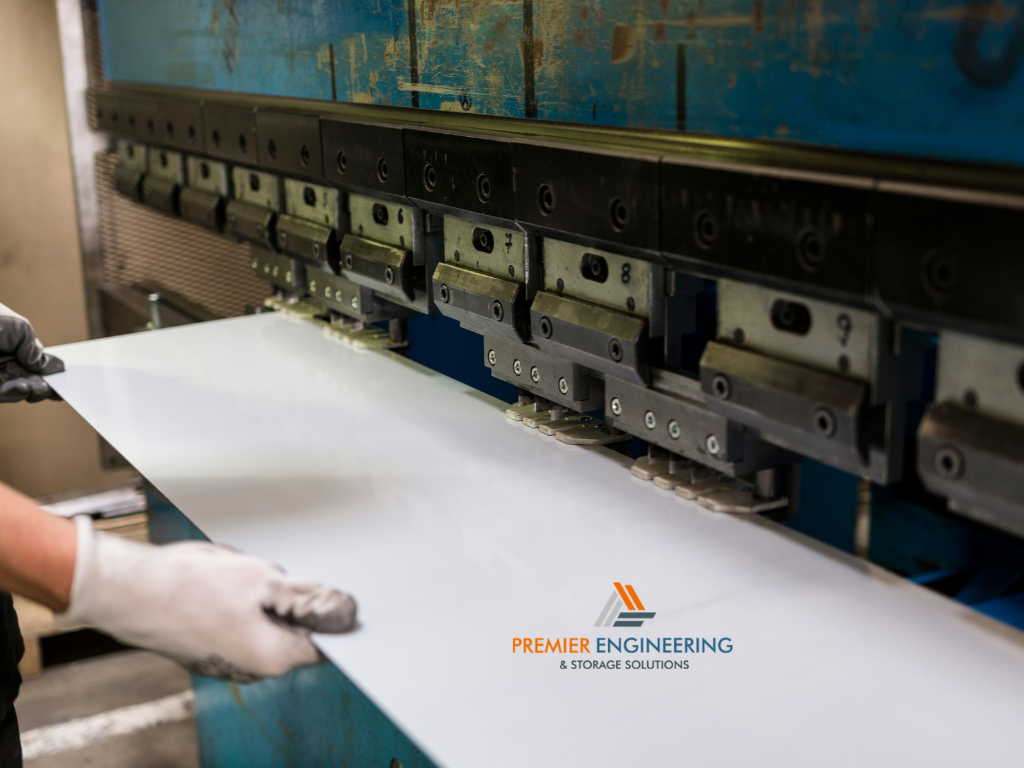
A part with several flanges may need to be repositioned multiple times in a metal bending press or press brake. As bends are added, earlier features can begin to interfere with the punch, die or machine frame.
The order of operations therefore becomes important.
A bend that is easy to complete first may make a later bend impossible. In other cases, the component may need a particular sequence simply to maintain access to each bend line.
Good design-for-manufacture considers this before production begins.
The aim is not to remove every complex feature. It is to make sure the required shape can be formed consistently with suitable tooling and a practical sequence.
Premier Engineering currently lists design, prototyping, CNC brake press work, CNC punching and laser cutting among its manufacturing capabilities, illustrating why early design review can be valuable when several processes need to work together.
Allow for Bend Radius and Material Thickness
CNC Sheet Metal Fabrication: Choose a Suitable Bend Radius
CNC sheet metal fabrication designs need an appropriate inside bend radius.
A bend cannot always be made as tight as the CAD model allows.
Minimum bend radius depends on factors including material type, thickness, hardness, heat treatment and grain direction. Trying to force a radius that is too tight can increase stress at the outside of the bend and raise the risk of cracking or other forming problems.
This matters because different materials behave differently.
A radius that works for one aluminium grade may not suit stainless steel of the same thickness. Even materials within the same general family can have different forming characteristics.
The safest approach is therefore not to apply one universal bend-radius rule to every CNC sheet metal fabrication project.
Instead, the radius should be considered alongside the specified material, thickness and forming process.
Using consistent bend radii where practical may also simplify production because fewer tooling changes may be needed across the component.
If the design genuinely requires a tight radius, discuss it with the fabricator before the part reaches production.
CNC Sheet Metal Fabrication: Account for Material Thickness
CNC sheet metal fabrication also needs to consider how increasing sheet thickness affects forming.
Thicker material generally requires more forming force and different tooling arrangements than thinner sheet.
Thickness can also influence the practical bend radius and the size of the die opening used during press-brake work.
That means material thickness is not simply a strength decision.
Changing from one sheet thickness to another can affect the flat pattern, bend allowance and finished dimensions.
This is particularly important when an existing design is being modified.
Increasing sheet thickness without reviewing the bends may produce a component that no longer fits the intended assembly even though the overall CAD geometry appears unchanged.
For high-precision sheet metal parts, the relationship between thickness and bend geometry should therefore be confirmed before production files are released.
The same principle applies when a component will later be welded, fastened or assembled with another part. Small dimensional changes caused by bending can become much more noticeable once several components need to align.
Understand Bend Allowance and Flat Patterns
CNC Sheet Metal Fabrication: Allow for Material Movement
CNC sheet metal fabrication requires an understanding of what happens to the sheet as it bends.
The outside surface stretches while the inside surface compresses. Between those areas is a neutral region that behaves differently from either surface.
Because of this material movement, the length of the finished bent component cannot always be calculated by simply adding the straight dimensions together.
The flat pattern needs to compensate for the material consumed through the bend.
This is where concepts such as bend allowance, bend deduction and K-factor become relevant.
The K-factor is used to help estimate the position of the neutral axis through the bend, which in turn affects the developed flat length. Material, radius, forming method and thickness all influence the result.
Modern sheet-metal CAD software can assist with these calculations, but the settings still need to reflect the actual fabrication process.
CNC sheet metal fabrication therefore benefits from using bend data that matches the fabricator’s tooling and forming approach rather than relying blindly on a generic CAD default.
CNC Sheet Metal Fabrication: Check Dimensions Before Production
CNC sheet metal fabrication becomes particularly sensitive to bend calculations when a part contains several bends.
A small dimensional difference at one bend may affect where the next flange finishes.
When several bends are involved, those differences can accumulate and affect hole alignment, overall width or how the component fits into an assembly.
This is one reason high-precision sheet metal parts should be reviewed in their formed state as well as in the flat pattern.
Important dimensions should be defined according to the functional requirements of the finished component.
If a bracket needs to fit between two surfaces, for example, the final formed width may matter more than a particular flat-pattern dimension.
Similarly, if two holes need to align with another component after bending, their relationship in the finished part deserves careful attention.
Prototyping can be useful where the geometry is new or several tolerances interact.
Premier Engineering currently lists both design and prototyping among its sheet-metal manufacturing capabilities, alongside CNC brake press work and other fabrication processes.
For CNC sheet metal fabrication, checking the formed component before committing to a larger production run can help identify whether bend compensation or feature positioning needs refinement.
Position Holes and Features Away From Bend Lines
CNC Sheet Metal Fabrication: Protect Holes Near Bends
CNC sheet metal fabrication often includes holes, slots, notches and other details that are created before forming.
Their position relative to the bend line matters.
A hole positioned very close to a bend can distort as the surrounding material stretches and compresses. Slots, notches and cut-outs can experience similar changes.
This can leave a feature that was perfectly round or square in the flat sheet looking different after forming.
The required clearance depends on the material, thickness, bend radius and geometry, so there is no single spacing value that should be applied to every design.
Sheet-metal design guidance commonly treats feature spacing, bend radii and hole placement as related design-for-manufacture considerations rather than independent dimensions.
For CNC sheet metal fabrication, ask whether a hole genuinely needs to sit close to the bend.
Moving it slightly may create a simpler and more repeatable manufacturing outcome without affecting the function of the component.
Where the position cannot change, the fabricator may need to consider how the feature is produced or whether another manufacturing sequence is more suitable.
CNC Sheet Metal Fabrication: Coordinate Cutting and Punching
CNC sheet metal fabrication frequently combines more than one manufacturing process.
A flat blank may be produced using cnc cutting services, while repeated holes, slots or formed features may suit metal punching services or a cnc punching service.
A cnc cutting machine can produce detailed profiles efficiently, but the cutting stage should still anticipate what will happen when the component reaches the press brake.
The same applies to punching.
A feature that can be punched easily into a flat sheet may not remain in the same condition after a nearby bend.
Premier Engineering currently provides laser cutting, CNC punching and CNC brake press services as part of its sheet-metal production capabilities. Its turret punching service is positioned for punched sheet-metal features, while its press-brake capability handles the later forming stage.
For customers comparing cnc cutting services or a cnc punching service, it is therefore useful to provide the complete part rather than only the cutting drawing.
The fabricator needs to know that the flat profile will later be bent.
That context can influence feature positioning, manufacturing sequence and whether cutting or punching is the more practical process for a particular detail.
Match the Material to the Bend Requirements
CNC Sheet Metal Fabrication: Consider How Metals Bend Differently
CNC sheet metal fabrication needs to account for the properties of the chosen metal.
Mild steel, stainless steel and aluminium do not respond identically to forming.
Yield strength, ductility and hardness influence how much force is required, how tightly the material can be bent and how much elastic recovery may occur after the forming load is removed.
That elastic recovery is known as springback.
After the metal bending press releases the component, the formed angle may open slightly rather than remaining exactly where the tooling positioned it.
Springback varies with the material, bend radius, thickness and forming method. Higher-strength materials can require greater compensation.
For CNC sheet metal fabrication, material should therefore be selected for both its end use and its manufacturability.
Corrosion resistance, strength, weight and appearance may drive the original material choice, but bendability still needs to be part of the discussion.
Changing the metal after a design has already been finalised may require the bend geometry or process assumptions to be reviewed.
CNC Sheet Metal Fabrication: Plan CNC Stainless Steel Parts
CNC sheet metal fabrication involving cnc stainless steel deserves particular attention to bending.
Stainless steel is widely selected where corrosion resistance, appearance or mechanical properties are important, but its forming behaviour differs from softer materials.
Depending on grade and condition, stainless steel can require greater forming force and can display more springback than lower-strength materials. Bend radius and tooling therefore need to suit the specific material rather than being copied from a mild-steel design.
This becomes important when producing high-precision sheet metal parts with several bends.
If final dimensions are critical, the relationship between the cutting file, bend allowance and actual press-brake process needs to be controlled.
Surface requirements can matter as well.
If the stainless steel has a visible finish, handling and forming need to account for the required appearance of the finished component.
For cnc stainless steel projects, identifying the grade, thickness, finish and bend requirements at the quoting or design-review stage gives the fabricator more useful information than simply specifying “stainless steel”.
Consider Tooling and Press Brake Limitations
CNC Sheet Metal Fabrication: Design for the Metal Bending Press
CNC sheet metal fabrication designs ultimately need to work with real tooling.
A metal bending press, more commonly described in sheet-metal manufacturing as a press brake, uses a punch and die to form the component.
The selected tooling affects the bend radius, required force and physical space available around the part.
Bend length matters because the machine needs sufficient capacity for the component being formed.
Large panels can also create handling considerations that are less significant with small brackets or enclosures.
Modern press-brake systems allow controlled, repeatable forming, but they still operate within physical tooling and machine constraints.
Premier Engineering states that it uses Amada HG press brakes for its CNC brake press capability and combines that process with its wider sheet-metal manufacturing services.
For CNC sheet metal fabrication, this means the design should ideally be reviewed against the available tooling before production begins.
If the intended bend requires unusual tooling or creates a clearance problem, it is usually better to identify that during design review than after the parts have already been cut.
CNC Sheet Metal Fabrication: Avoid Difficult Bend Sequences
CNC sheet metal fabrication becomes more challenging when several bends restrict access to one another.
A simple open bracket may be straightforward to form.
A box-like component with short return flanges, closely spaced bends or enclosed geometry can require much more planning.
The problem is not necessarily that an individual bend is difficult.
The difficulty may appear only after another bend has already been completed.
An earlier flange can collide with the press-brake tooling or prevent the component from being positioned correctly for the next operation.
This is why bend sequence should be considered during design.
Where practical, keeping similar bends consistent and reducing unnecessary changes in direction can simplify forming. Sheet-metal design guidance also notes that arranging bends in ways that reduce part reorientation can improve manufacturability.
That does not mean every CNC sheet metal fabrication part needs to be visually simple.
It means complex geometry should have a deliberate manufacturing path.
When there is uncertainty, a fabricator can review the model and identify whether a small change to flange length, bend position or component structure could make the sequence more practical.
Review the Design Before Sending It to Production
CNC Sheet Metal Fabrication: Check the Complete Manufacturing Process
CNC sheet metal fabrication should be reviewed as a complete sequence before production files are released.
The part may begin with a cnc cutting machine or CNC punch, move to a metal bending press and then continue through welding, fastener insertion or finishing.
A decision made for one process can affect the next.
A hole moved to simplify punching may end up too close to a bend. A tight flange added for appearance may restrict press-brake access. A material substitution may change springback or the required bend radius.
That is why design-for-manufacture is most useful when the complete component is considered rather than optimising each process independently.
Premier Engineering currently lists services spanning design, prototyping, laser cutting, CNC punching, CNC brake press work, welding, fastener insertion and several finishing processes from its operation in Ingleburn in south-west Sydney.
For a customer needing CNC sheet metal fabrication, that makes the design stage a natural point to discuss how the part will move through cutting, punching, bending and any later assembly or finishing work.
Internal links from an article like this can also direct readers naturally to relevant CNC cutting services, CNC punching, brake press, design or prototyping pages when they need more information about a particular stage.
CNC Sheet Metal Fabrication: Confirm Files With the Fabricator
CNC sheet metal fabrication is easier to assess when the fabricator receives complete project information.
A useful production file should communicate the material, thickness, quantity, finished geometry and any important dimensional or finish requirements.
Where bends are involved, providing both the 3D model and appropriate manufacturing drawings can help clarify the intended result.
The fabricator can then review how the part will be cut, punched and formed.
Premier Engineering states that it assists with design and production stages and currently offers CNC punching, laser cutting and CNC brake press services. Its website also provides a project enquiry process that allows customers to submit material, quantity, size and files for assessment.
For projects involving a cnc punching service, metal punching services or cnc cutting services, sending the complete component design rather than an isolated flat profile can make the manufacturing intent much clearer.
Bending should never be treated as an afterthought in CNC sheet metal fabrication.
The bend radius, material thickness, springback, feature placement, tooling access and bend sequence all influence how closely the manufactured part follows the original design.
By considering those factors early, designers and buyers can create components that are easier to manufacture and more likely to assemble as intended.
Where a project involves complex bends, cnc stainless steel, tight dimensional relationships or several connected fabrication stages, an early design review with the fabricator is a practical next step. It allows cutting, punching and bending requirements to be considered together before production begins.