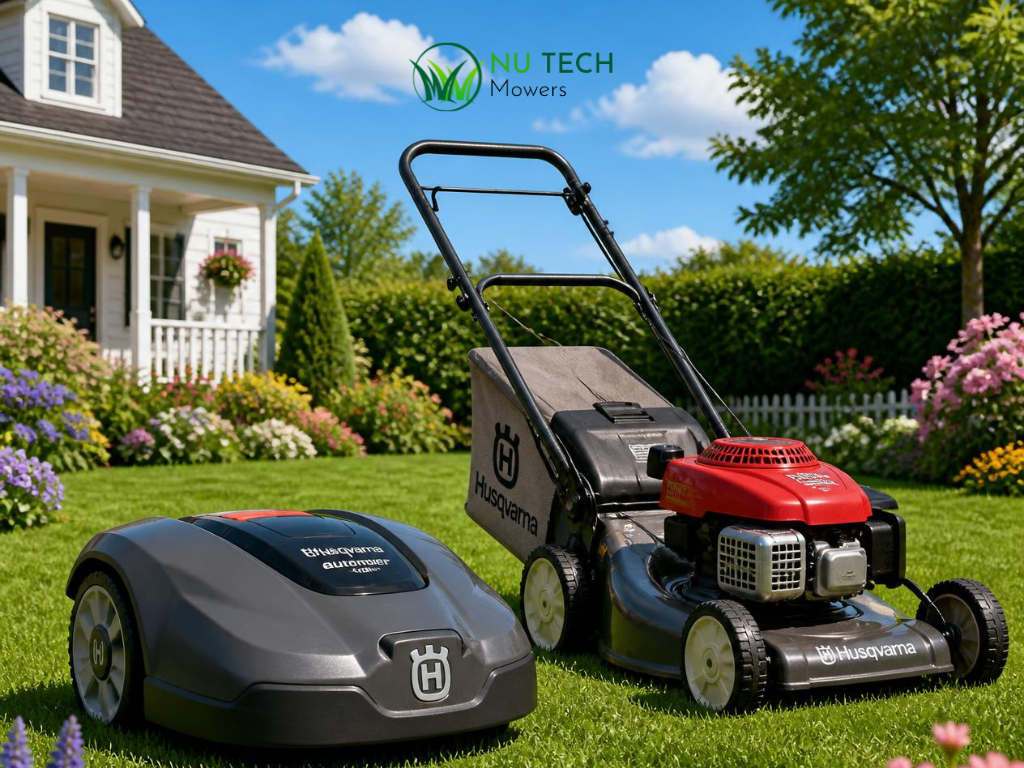
Choosing the right Husqvarna mower for a small Australian backyard involves more than comparing cutting power or price. Homeowners can choose between traditional push mowers that provide direct control and robotic models that maintain suitable lawns automatically. Both options have advantages, but the best choice depends on the size and layout of your lawn, your maintenance preferences and how much you want to spend.
A compact lawn may seem easy to maintain, but narrow passages, garden beds, uneven ground and different grass varieties can make mower selection more complicated.
For example, a small, open lawn may be straightforward to mow manually. A similarly sized garden with several separate grass areas might require more planning, particularly if you are considering robotic mowing.
Husqvarna offers conventional lawn mowers and Automower robotic models for different residential requirements. Understanding how they operate can help you decide whether automation offers enough practical value to justify the additional investment.
How a Husqvarna Mower Works for Smaller Lawns
A conventional push mower is operated by someone walking behind the machine and guiding it across the lawn.
Depending on the model, the mower may use a petrol engine or electric motor powered by a rechargeable battery. Some models require the operator to provide the forward movement, while self-propelled versions use a drive system to assist.
Push mowers allow homeowners to choose exactly when and where to mow.
They may also offer grass collection, mulching or discharge options, depending on their design.
A Husqvarna Automower works differently.
Once a compatible robotic mower has been correctly installed and configured, it can maintain a designated lawn area through regular cutting.
It operates within defined boundaries, returns to its charging station when required and follows the operating arrangements supported by the particular model.
Unlike conventional mowing, which may remove a noticeable amount of grass during each session, robotic mowing generally relies on frequent cutting of small amounts of growth.
The fine clippings are left on the lawn rather than collected in a conventional catcher.
This difference means an Automower is primarily intended for ongoing lawn maintenance, not for rapidly clearing heavily overgrown grass.
Should You Choose an Automower or Push Mower?
For a small, uncomplicated backyard, a push mower may be the more practical choice.
It requires no permanent robotic mowing installation, gives you direct control around obstacles and can be stored away after use.
A battery-powered model may appeal to homeowners who prefer to avoid petrol engine maintenance, while a petrol mower may suit those comfortable with conventional engine operation.
A robotic mower becomes more attractive when regular mowing takes time away from other activities.
Once the installation is suitable, an Automower can maintain the designated area without the homeowner manually guiding it through every mowing session.
However, automation still requires supervision of the operating environment, blade replacement, cleaning and occasional attention to obstacles or system alerts.
The purchase price and installation requirements may also be greater than those of a conventional push mower.
Before choosing, consider how often you mow, whether you enjoy doing the work and how much value you place on reducing routine mowing effort.
The answer will be different for every household.
Comparing Mowing Performance on Small Australian Lawns
Mowing performance is an important consideration when comparing Husqvarna mower options for smaller residential properties.
Australian lawns can contain different grass varieties, uneven sections and areas affected by shade or seasonal growth.
The way a mower handles these conditions matters more than whether it is described as robotic or conventional.
Cutting Quality, Grass Height and Regular Maintenance
Robotic and push mowers maintain grass in different ways.
A robotic mower normally operates regularly enough to remove small amounts of new growth.
This can help maintain a consistent appearance when the mower is correctly configured and the grass remains within its supported operating conditions.
A push mower is usually used less frequently, allowing the operator to choose when mowing is needed.
This provides flexibility when grass grows unevenly or seasonal conditions change.
For example, couch grass may require more frequent attention during active summer growth, while buffalo grass is often maintained at a different cutting height.
Kikuyu can also grow vigorously in favorable conditions and may require adjustments to mowing frequency.
There is no single cutting height suitable for every Australian lawn.
The correct setting depends on the grass variety, season, growing conditions and manufacturer guidance.
Homeowners should also avoid removing excessive grass length in one mowing session, particularly during periods of heat or other lawn stress.
A push mower may offer a practical advantage when grass has grown longer than usual, provided the machine is suitable for the conditions and the operator follows safe mowing practices.
An Automower performs best when it can maintain grass regularly rather than recover a lawn that has become substantially overgrown.
Whichever mower you choose, sharp blades and appropriate cutting settings are important for maintaining lawn quality.
How Lawn Shape, Slopes and Obstacles Affect Mowing
The shape of your lawn can be just as important as its total area.
A rectangular lawn with relatively few obstacles may suit either a conventional or robotic mower.
A garden divided by pathways, garden beds and narrow access points may require more careful planning.
A push mower allows the operator to steer directly around trees, landscaping features and uneven sections.
However, repeatedly turning a heavy mower in a confined area may become inconvenient.
Robotic mowers use supported navigation systems and defined mowing boundaries.
Some Husqvarna Automower models operate within physical boundary wires, while compatible models can use virtual boundaries.
The appropriate installation depends on the exact mower and the characteristics of the property.
For example, a narrow passage between fences or walls may affect whether a wire-free mower can maintain reliable satellite positioning.
Physical boundary-wire models can have different passage requirements.
Slopes also require attention.
A mower’s maximum supported slope is specific to the model, and a slope rating for the main mowing area may differ from its permitted slope at the boundary.
Homeowners should not assume every robotic mower can safely handle steep or uneven ground.
Similarly, manually operating a push mower on slopes requires care and compliance with the manufacturer’s instructions.
Before purchasing, measure the lawn area, examine narrow passages and identify any steep, slippery or difficult sections.
These details can help determine whether a mower is suitable for the property.
Understanding the Costs of Robotic and Push Mowers
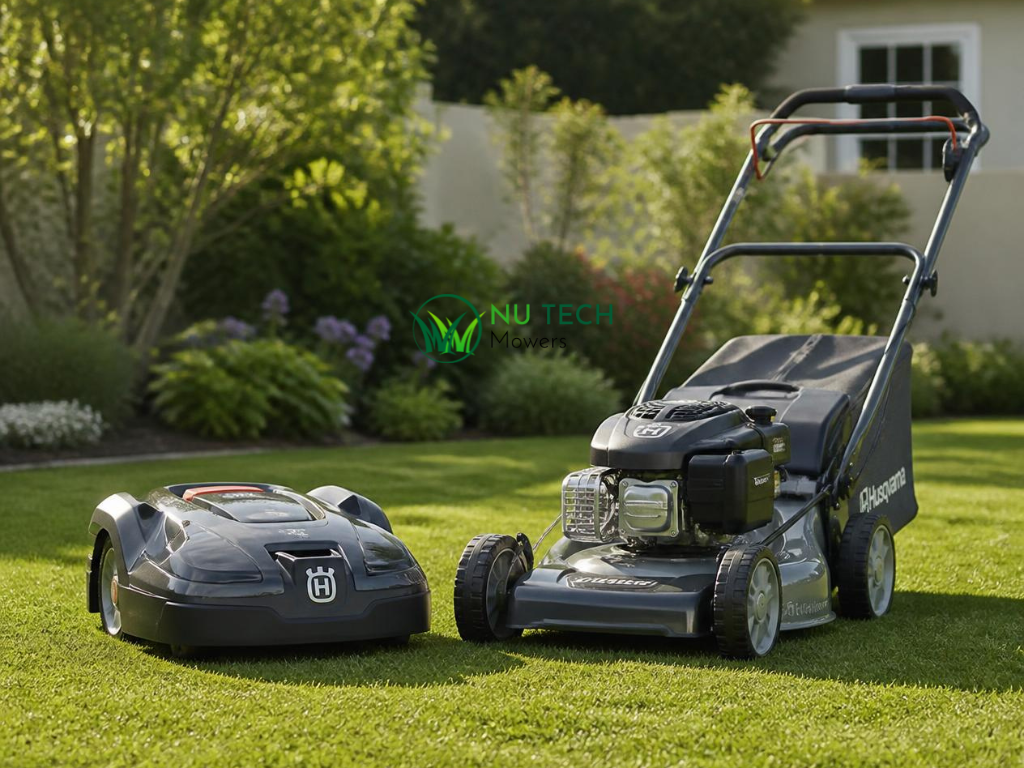
The cost of owning a Husqvarna mower should be considered over its useful life rather than judged solely by the purchase price.
A conventional push mower often involves a simpler initial purchase, while robotic mowing may require additional installation equipment and setup.
However, ongoing costs vary according to the model, usage, maintenance requirements and the services needed.
Husqvarna Mower Purchase and Installation Costs
A push mower is generally straightforward to prepare for use.
After following the manufacturer’s assembly and operating instructions, the homeowner can begin mowing a suitable lawn.
A petrol model requires the correct fuel and routine engine checks, while a battery model needs a compatible charged battery and charger.
A robotic mower normally requires more initial preparation.
The installation must establish the designated mowing area, an appropriate charging station location and any required navigation or boundary arrangements.
For physical boundary-wire models, the installation may involve positioning perimeter wires, guide wires and related components.
These define the operating area and help the mower navigate according to its supported system.
Compatible wire-free Husqvarna Automower models use satellite-based positioning to establish virtual boundaries.
However, wire-free operation does not mean that every garden is automatically suitable.
Buildings, tall hedges, trees and other obstructions can affect reception and may require additional planning.
Some installations also depend on compatible accessories, positioning equipment or connectivity arrangements.
A homeowner may be able to complete an installation independently using the official instructions.
Professional setup may be useful where the property includes difficult slopes, complicated boundaries or several separate lawn areas.
When comparing costs, ask what comes with the mower and whether installation materials or services are included.
Do not assume the advertised mower price covers every component required for your property.
Ongoing Expenses, Blades, Batteries and Servicing
Push and robotic mowers have different maintenance requirements.
A petrol push mower may require engine oil changes, air filter attention, spark plug maintenance and other servicing specified in its operator manual.
A battery push mower avoids petrol engine servicing but still requires blade checks, cleaning and appropriate battery care.
A robotic mower uses electricity for charging and requires inspection and replacement of its cutting blades as necessary.
Owners also need to maintain the mower’s wheels, charging contacts and other components according to the manufacturer’s instructions.
Batteries have a limited service life, and replacement may eventually be necessary.
For a robotic mower with physical boundary wires, damaged wiring may create additional maintenance work.
Wire-free systems avoid physical perimeter-wire repairs but can involve other hardware or connectivity considerations.
Storage also matters.
Owners should follow the manufacturer’s recommendations for battery care, cleaning and periods when the mower is not in use.
A robotic mower can reduce the time spent manually cutting the lawn, but that benefit needs to be considered alongside electricity use, servicing and eventual component replacement.
A push mower may have lower initial complexity, but it requires the homeowner to carry out each mowing session.
The most suitable option depends on the value you place on convenience as well as the total expected ownership cost.
Choosing Between Automation and Manual Lawn Care
Convenience is one of the main reasons homeowners compare an automated Husqvarna mower with a conventional push mower.
A robotic system can reduce the need for regular manual mowing, while a traditional mower allows the homeowner to decide exactly when the grass is cut.
Neither approach eliminates the need to monitor lawn conditions and maintain equipment.
How Husqvarna Automower Technology Saves Mowing Time
A properly installed Husqvarna Automower can maintain its designated lawn area according to supported schedules and settings.
Depending on the model, owners may be able to manage operating times and other functions through the Automower Connect app.
The mower returns to its charging station automatically when required.
This approach can be useful for homeowners who want to maintain their lawn regularly without setting aside time for each mowing session.
For example, someone with a suitable compact lawn may prefer to have the grass maintained through scheduled operation rather than mowing manually on weekends.
The convenience becomes particularly relevant during periods when grass is growing quickly.
However, the mower must remain suitable for the changing condition of the lawn.
Owners may need to adjust schedules or cutting heights as growth patterns change.
Obstacles, garden work and temporary lawn changes can also require intervention.
Robotic mowing does not automatically maintain hedges, remove fallen branches or complete every area of lawn edging.
The system should also be scheduled to avoid conditions that create unnecessary risks for people, pets and wildlife.
For homeowners who value regular automated lawn maintenance, these responsibilities may be acceptable in exchange for reduced manual mowing.
When a Push Mower Offers More Practical Control
A push mower gives the homeowner direct control over mowing time, direction and pace.
This can be helpful for smaller properties where the lawn contains several obstacles or frequently changing garden areas.
For example, a homeowner may move outdoor furniture, children’s play equipment or portable garden items before mowing.
With a conventional mower, these changes can be managed during the mowing session.
A push mower also makes it easier to respond directly to variations in grass height.
If one area has grown more quickly than another, the operator can adjust the mowing approach within the machine’s safe operating limits.
There are practical advantages to manual mowing when the grass is only maintained occasionally.
A homeowner who mows infrequently may not gain enough benefit from automated operation to justify the additional setup and expense.
Storage space may also influence the decision.
A compact push mower with a suitable folding handle can be convenient where garage or shed space is limited.
However, manual mowing requires physical effort.
Some homeowners may prefer a self-propelled mower if pushing the equipment becomes uncomfortable, although the suitability of that option depends on the size and layout of the lawn.
For a very small property, the simplicity of a push mower may outweigh the convenience of automation.
Managing Lawn Edges, Garden Beds and Other Equipment
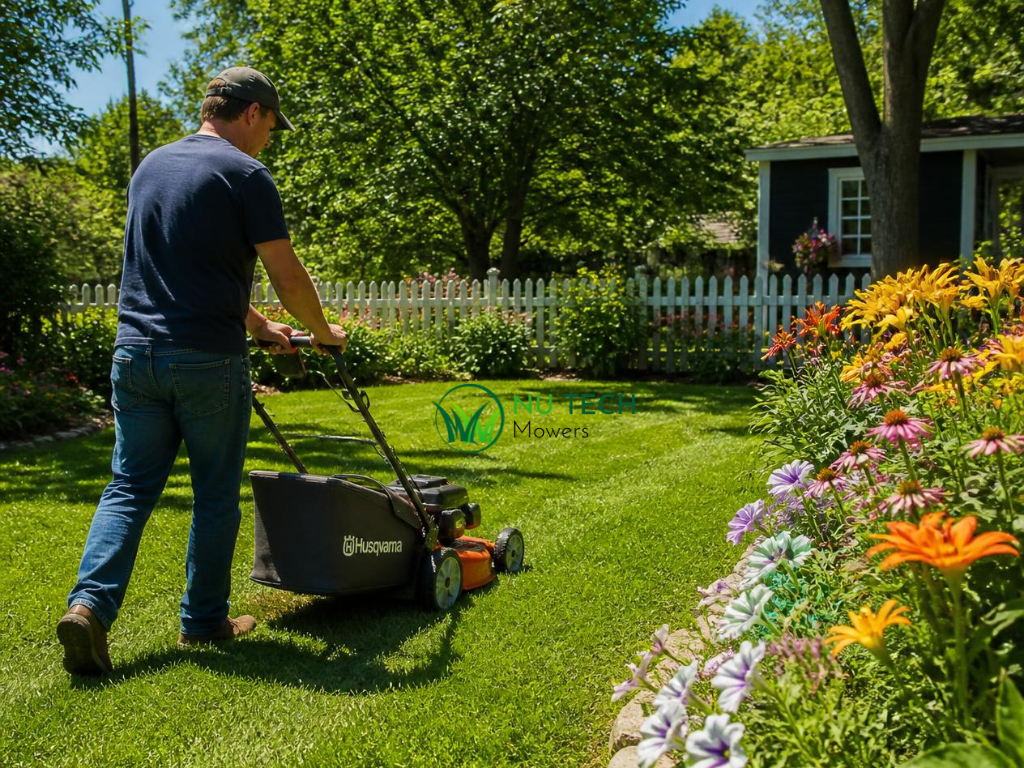
Choosing a Husqvarna mower is only one part of planning how to maintain a residential garden.
Lawn edges, narrow spaces, garden beds and hedges may require separate attention regardless of whether the main grass area is maintained manually or automatically.
Understanding the role of additional equipment can help homeowners avoid purchasing tools they do not need.
Why a Robot Mower May Still Need a Trimmer
Robotic mowers generally work within a defined cutting area, but the cutting system may not reach every section beside fences, walls or raised garden beds.
The amount of edging required depends on the mower’s design, installation and surrounding landscape.
Some Husqvarna Automower models include features intended to reduce the need for manual edge trimming.
However, homeowners should check which features are included with the specific model they are considering.
A grass trimmer can be useful for maintaining areas the mower cannot reach conveniently.
These may include grass growing beside garden borders, around certain fixed objects or along narrow edges.
A conventional push mower may also leave sections requiring a trimmer, particularly where its cutting deck cannot safely reach the boundary.
The equipment should be matched to the intended task.
A headge trimmer is designed for suitable grass and edge maintenance, while a hedge trimmer is used for appropriate hedges and shrubs.
A hedge trimmer should not be treated as a substitute for a lawn mower or grass trimmer.
Homeowners should also consider how garden design influences ongoing maintenance.
Appropriate edging arrangements and clearly defined lawn boundaries can make mowing easier, regardless of the equipment used.
Do Small Yards Need a Ride On Mower or Other Equipment?
A ride on mower is generally unnecessary for a typical small residential backyard.
Ride-on equipment is designed for mowing applications where its size, cutting capacity and operating characteristics provide practical advantages.
On a compact lawn with several corners, garden beds or narrow gates, a larger machine may be difficult to manoeuvre or store.
A push mower can often complete these tasks with less complexity.
A robotic mower may also suit smaller properties where automated cutting is a priority and the lawn meets the model’s requirements.
However, the total property size does not always reflect the area that needs mowing.
A large residential block may have only a small section of grass.
Another property may contain an extensive open lawn that could justify considering larger equipment.
Before selecting a ride-on machine, homeowners should assess the actual mowing area, access widths, turning space and storage requirements.
Additional equipment such as a grass trimmer or hedge trimmer should be chosen according to the surrounding garden.
The aim is to maintain the property efficiently without investing in equipment that offers little practical benefit for the available space.
Comparing Convenience, Safety and Ongoing Care
Safe operation and appropriate maintenance are essential when choosing any Husqvarna mower.
Although robotic and conventional mowers use different operating methods, both contain moving cutting components and must be used according to the manufacturer’s instructions.
Homeowners should consider the people, animals and conditions surrounding the mowing area rather than assuming that an automated system can operate without any precautions.
Safety Features and Responsible Husqvarna Mower Operation
Husqvarna robotic mowers include safety-related features that vary by model.
Certain systems can respond when the mower is lifted or overturned, but these features do not eliminate the possibility of injury.
Children and pets should be kept away from the mowing area while the machine is operating.
Owners should also inspect the lawn for toys, tools, stones and other objects that could interfere with cutting.
Wildlife deserves particular consideration.
Small animals may be active in gardens during the evening or overnight, and robotic mowing schedules should be planned to avoid exposing them to moving blades.
Daylight operation can be a more suitable precaution where wildlife may be present.
Homeowners should never rely solely on obstacle detection as a substitute for checking that the work area is clear.
A push mower requires its own precautions.
Operators should wear suitable footwear, check the mowing area and follow the manufacturer’s instructions for safe handling.
Before inspecting or cleaning cutting components, the mower must be stopped and secured according to its operating manual.
For battery equipment, this may involve removing or isolating the battery where instructed.
For petrol equipment, the manufacturer’s maintenance precautions should be followed.
Safe mowing also depends on the ground conditions, weather and slope.
A lawn mower should not be used outside its stated operating limits.
Cleaning, Storage and Seasonal Lawn Maintenance
Regular maintenance helps preserve mower performance and reduce avoidable problems.
Grass accumulation around cutting areas and wheels can affect operation.
However, cleaning methods vary between models.
Owners should follow the relevant instructions rather than assuming every mower can be cleaned with a pressure washer or hose.
Blades should be inspected for wear or damage and replaced or maintained as specified by the manufacturer.
Battery-powered equipment should be stored and charged under suitable conditions.
Petrol mowers require the recommended engine maintenance and appropriate handling of fuel.
Robotic mowers may also need attention to their charging station, navigation components and seasonal operating settings.
Australian lawn growth changes throughout the year.
During periods of warmer weather and active growth, mowing may be required more frequently.
In cooler or drier conditions, growth may slow and the lawn may benefit from a different maintenance routine.
Grass variety, watering arrangements and local conditions all influence the appropriate schedule.
A robotic mower’s automation settings can make these adjustments easier on supported models, but owners still need to monitor the lawn.
A conventional push mower allows the homeowner to make the changes manually.
Whichever option you choose, regular maintenance should be treated as part of normal ownership rather than something to consider only when the mower stops working.
Finding the Right Lawn Mower for Your Property
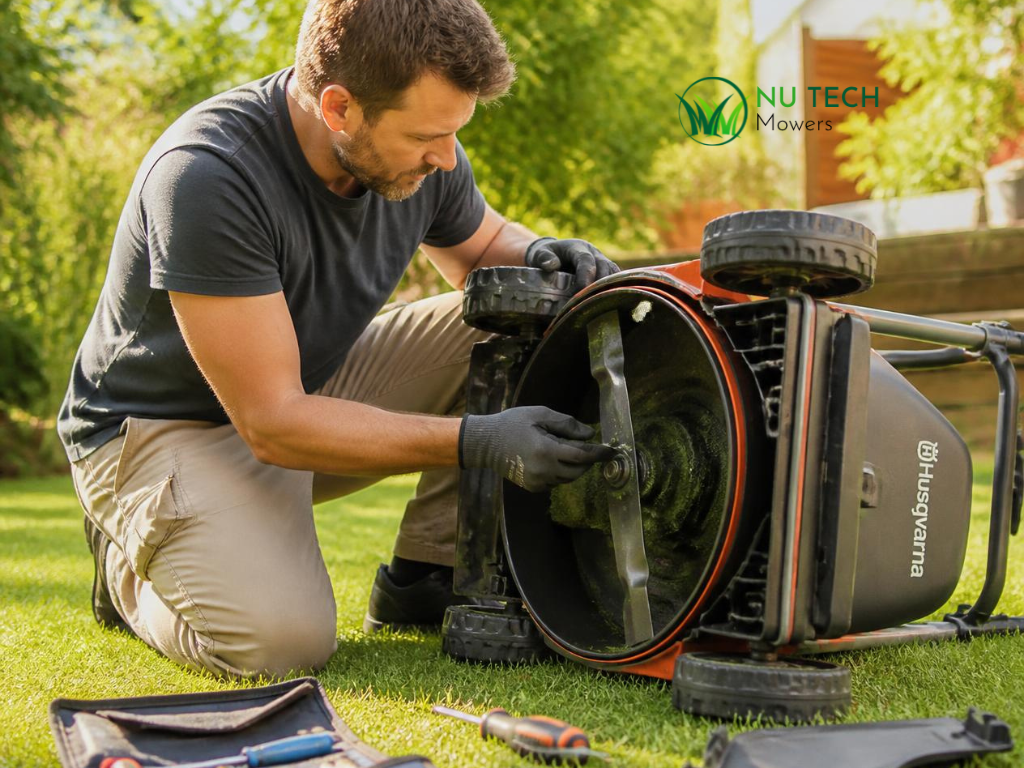
Selecting a Husqvarna mower for a small yard should begin with the characteristics of the lawn and the homeowner’s preferred maintenance routine.
The best option is not necessarily the most advanced or expensive machine.
It is the mower that can safely and reliably maintain the property without introducing unnecessary work, cost or complexity.
Questions to Ask Before Buying a Husqvarna Mower
Before purchasing, establish the approximate area of grass that needs to be maintained.
The total land size may include buildings, paved spaces, garden beds and other areas that do not require mowing.
The actual lawn area provides a more useful starting point.
Next, consider the layout.
Narrow passages, separate grass sections, slopes and fixed obstacles can affect which mower models are suitable.
For robotic mowing, ask whether the garden supports a physical boundary-wire installation, compatible wire-free technology or another model-specific arrangement.
The mower’s capacity and slope specifications should be checked against the property.
It is also worth asking about installation materials, charging station placement, maintenance requirements and replacement parts.
Homeowners considering a conventional mower should compare cutting width, collection or mulching options, mower weight and available power sources.
If physical effort is a concern, it may be appropriate to compare push and self-propelled models.
Warranty conditions and service support should also be understood before purchase.
For an Automower, confirm how installation, setup assistance and ongoing servicing are handled.
Providing a dealer with a lawn sketch, approximate area measurements and details of slopes or narrow access points can help make the discussion more productive.
Making the Final Choice for Your Small Yard
A conventional push mower may be the most practical option for a compact, simple lawn where the homeowner is comfortable mowing manually.
It provides direct control, avoids permanent robotic installation and allows mowing whenever conditions are suitable.
A robotic mower may be worth the additional investment when the lawn is compatible with the selected model and the homeowner values regular automated maintenance.
However, the cost should be justified by the convenience and usefulness of the system rather than technology alone.
For Australian homeowners comparing mower options, Nu Tech Mowers supplies lawn and garden equipment, including Husqvarna products.
Its published range includes Husqvarna equipment, robotic mowers and push mowers.
The robotic mower range lists products such as the Husqvarna Automower 305, which is designed for smaller and more complex lawn areas.
Nu Tech Mowers also provides mower sales, servicing and related support, with a Husqvarna-listed retail and service location in Cartwright, Western Sydney.
Customers should confirm current product availability, model features and installation arrangements before purchasing.
If you are unsure whether a robotic or push mower is suitable for your backyard, contact Nu Tech Mowers to discuss your lawn size, layout and maintenance preferences.
A smaller lawn does not automatically require a robotic mower, and a conventional push mower is not necessarily the right choice for every household.
By comparing mowing requirements, installation, ownership costs and safety, you can choose equipment that fits your property and the way you prefer to maintain it.