
Ads online can help Australian businesses reach local customers who are more likely to need their products or services. The challenge is not simply getting more clicks. It is making sure those clicks come from people in the right locations, with the right intent, and with a realistic opportunity to become customers.
Effective online advertising combines location targeting, service areas, exclusions, audience signals, search intent and relevant landing pages. For businesses that advertise online, the goal should be to reach useful prospects rather than the largest possible audience.
A well-planned local campaign can help reduce irrelevant traffic and make advertising spend easier to evaluate.
Ads online should begin with a clear understanding of the type of customer the business actually wants.
Location matters, but so do service needs, buying intent and the action the business wants the person to take.
How ads online can focus on the right local audience
Ads online can become more relevant when the audience is defined before the campaign starts.
A local electrician may want to reach homeowners and businesses within a specific service area. A professional services company may be able to work with customers across Sydney or a much wider region.
The targeting should reflect the way the business actually operates.
Advertising online without clear customer criteria can generate traffic from people who live outside the service area or are looking for something different.
Before launching a campaign, define the locations you serve, the services you want to promote and the type of enquiry or sale you want to generate.
Why ads online need clear customer criteria
Ads online should not rely on geography alone.
Two people living in the same suburb may have completely different needs and levels of buying intent.
Search behaviour, service requirements and audience characteristics can all help determine whether someone is a useful prospect.
Local online advertising is therefore strongest when geography is combined with relevance.
A person searching for an emergency electrician in their suburb, for example, has a different intent from someone researching electrical renovation ideas for the future.
Match Ads Online to Real Service Areas
Ads online should reflect where the business can genuinely provide its services or deliver products.
Targeting a larger geographic area does not automatically create a better campaign.
How ads online can target suburbs and service areas
Ads online can be structured around suburbs, cities, regions or defined service zones, depending on the advertising platform and campaign type.
For a business operating throughout Sydney, a broader geographic campaign may be appropriate.
A business servicing only a small group of suburbs should use more focused targeting.
This is particularly important for trades and service businesses where travel time and distance affect whether a job is commercially practical.
Internet advertising should support the real service model rather than create enquiries from areas the business cannot reasonably serve.
Why ads online should reflect where you actually work
Ads online can waste budget when they promote a business in areas where customers cannot realistically receive the service.
The business location itself is not always the same as the service area.
A company based in Western Sydney may serve customers across Greater Sydney, while another business may only work within nearby suburbs.
The targeting needs to reflect that difference.
When businesses advertise online, the most useful geographic settings are those that align with actual delivery or service capabilities.
Use Ads Online Exclusions to Reduce Irrelevant Traffic
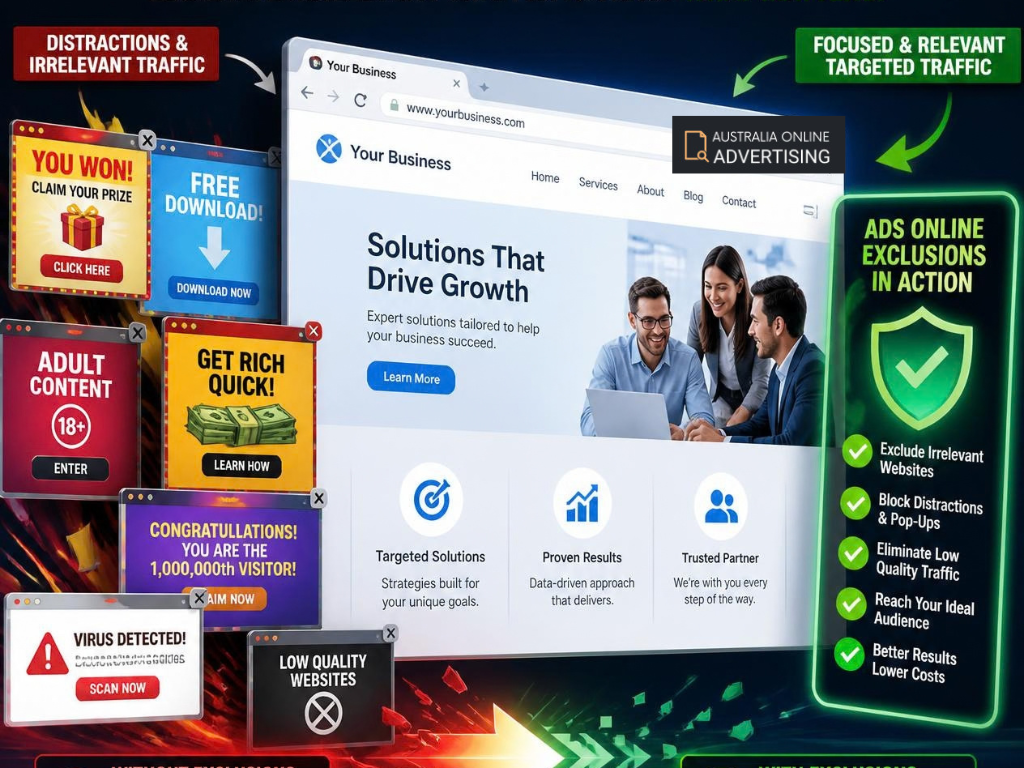
Ads online targeting is not only about deciding where advertising should appear.
It also involves deciding where advertising should not appear.
How ads online can exclude unsuitable locations
Ads online can use location exclusions to prevent campaigns from focusing on areas outside the business’s service range.
For example, a company targeting Greater Sydney may decide that certain distant areas are not practical because of travel costs, delivery restrictions or service limitations.
Removing those areas can help keep the campaign focused on more relevant customers.
This approach can be especially useful when internet advertising campaigns cover larger geographic regions.
Without appropriate exclusions, businesses may continue paying for clicks that are unlikely to become genuine enquiries.
How ads online can reduce low-value traffic
Ads online can also be refined by reviewing other sources of irrelevant traffic.
Depending on the advertising platform, businesses may be able to review search terms, audiences, devices, placements and other campaign signals.
The goal should not be to remove as much traffic as possible.
Over-targeting can make a campaign unnecessarily narrow.
Instead, businesses should use performance data to identify where money is being spent without producing meaningful outcomes.
If a location, search term or audience repeatedly produces clicks without enquiries, it deserves closer attention.
Connect Ads Online With Search Intent
Ads online become more useful when targeting reflects what the customer is actually trying to achieve.
Being geographically close to a business does not automatically mean someone is ready to buy.
How ads online can reach people with stronger intent
Ads online can use search terms and other signals to reach people who are actively looking for a relevant service.
Someone searching for a service with a suburb name, specific problem or urgent requirement may have stronger commercial intent than someone browsing general information.
This is one reason search-based internet advertising can be valuable for local businesses.
Search advertising is designed to respond to existing demand, while other formats such as display, social or video may be better suited to awareness and discovery.
The right format depends on what the business wants the campaign to achieve.
How ads online improve local online advertising relevance
Ads online should connect the customer’s search with a page that clearly answers their need.
If someone searches for a particular service in a particular location, sending them to a generic homepage can make the next step less clear.
Online advertising is more useful when the ad and destination page are closely connected.
The service should be obvious, the location should be relevant and the next step should be easy to understand.
Advertising online should also remain accurate. Businesses should not imply that they service locations they do not actually cover.
Combine Ads Online With Useful Audience Signals

Ads online can use audience information in addition to keywords and locations.
These signals can help refine targeting, but they should not make the campaign unnecessarily complicated.
How ads online can use audience signals carefully
Ads online may use factors such as interests, demographics, previous website visits and other audience signals where the advertising platform allows them.
These can provide additional context about potential customers.
However, adding more targeting layers does not automatically improve results.
A simple campaign with clear location settings, relevant search intent and strong landing pages may be easier to manage than a highly complex campaign with too many conditions.
The best approach depends on the business, customer journey and campaign goal.
Where ads online fit into Australian advertising strategies
Ads online can form part of a broader Online advertising Australia strategy that includes paid search, social advertising, display advertising, video and remarketing.
Not every business needs to use every channel.
A local service business may benefit from search advertising because customers are actively looking for help.
Another business may need social or video advertising to introduce its products before customers begin searching for them.
The right online advertising mix should follow how customers actually research and buy rather than simply copying what other businesses are doing.
Send Ads Online to Better Landing Pages
Ads online can reach the right person and still fail to generate an enquiry if the landing page creates confusion.
Targeting and landing-page experience need to work together.
How ads online should connect to local landing pages
Ads online should direct visitors to pages that clearly match the service or product being promoted.
A locally relevant landing page can explain what the business provides, where it operates and how customers can get in touch.
Local relevance does not require repeating suburb names throughout the page.
Instead, explain the genuine service area and make it clear whether the visitor can access the service.
The page should support the promise made in the advertisement.
If the ad promotes a specific service, that service should be easy to find when the person arrives.
Why ads online need clear conversion options
Ads online should give visitors an obvious next step.
Depending on the business, this could involve making a phone call, submitting an enquiry form, requesting a quote or booking a service.
Mobile usability is particularly important for local campaigns.
Contact buttons should be easy to use, forms should not be unnecessarily complicated and essential information should be easy to find.
If a potential customer has to search through multiple pages before they can make contact, even accurate targeting may not produce the desired result.
Review Ads Online and Improve Targeting Over Time
Ads online should not be treated as a campaign that is configured once and then ignored.
Performance data can reveal which parts of the targeting are working and where budget may be going to waste.
How ads online can identify stronger local markets
Ads online can provide information about which locations, search terms and campaigns are producing enquiries.
Businesses can compare results such as conversion rates, enquiry volume and cost per lead across different areas.
Over time, this can reveal useful patterns.
One suburb may generate a large number of clicks but very few leads. Another may generate less traffic but produce more genuine enquiries.
These differences can help guide future targeting and budget decisions.
The objective is not simply to increase traffic. It is to understand which traffic contributes to useful business outcomes.
When ads online may need professional advertising support
Ads online can become more difficult to manage when a business operates across several locations, uses multiple campaign types or spends a larger advertising budget.
Internet advertising services may be useful when a business needs help with campaign structure, geographic targeting, exclusions, tracking and ongoing optimisation.
When comparing online advertising companies, look beyond promises of higher traffic.
Ask how campaigns are measured, how irrelevant traffic is identified and how targeting decisions are reviewed over time.
Australia Online Advertising can be relevant for businesses considering how to advertise online and reach more appropriate local audiences across different internet advertising channels.
The strongest ads online campaigns are not necessarily those that reach the greatest number of people. They are the campaigns that reach relevant customers in the right locations, match genuine search intent and make the next step simple.
For Australian businesses, that means treating local targeting as an ongoing process. Define the customer, match the campaign to real service areas, exclude irrelevant traffic, improve landing pages and use actual enquiry data to refine the strategy over time.