Choosing commercial refrigeration is a bigger decision than simply comparing fridge sizes and prices. For a cafe, restaurant, bakery, bar, takeaway or food retailer, refrigeration affects food storage, staff workflow, energy use, available floor space and the ability to maintain appropriate temperatures throughout the trading day.
Businesses comparing commercial refrigeration Sydney options also have a wide range of equipment to consider. An upright storage fridge may work well for bulk ingredients, while an under-bench unit can keep frequently used products close to a preparation station. A customer-facing display refrigerator serves another purpose entirely, and businesses with larger stock volumes may eventually need a cool room rather than relying on several separate cabinets.
The right choice starts with understanding what your business needs to store and how staff will actually use the equipment.
Temperature control is particularly important for food businesses. The NSW Food Authority states that potentially hazardous cold food generally needs to be maintained at 5°C or below during storage and display. This includes many common hospitality products such as meat, seafood, dairy foods, prepared salads, cooked rice, pasta and sandwiches.
Energy use matters too. Australia’s Energy Rating program notes that commercial refrigerated cabinets can consume substantial amounts of electricity and recommends considering lifetime costs, including installation, maintenance and running costs, rather than focusing only on the initial purchase price.
This guide explains how to choose commercial refrigeration equipment according to storage needs, kitchen space, capacity, energy use and long-term support, while also looking at when buying, leasing or renting may make sense.
Match Refrigeration to Your Menu and Products
Before comparing brands or models, look at what actually needs refrigeration throughout a normal trading day.
A cafe serving coffee, sandwiches, cakes and cold drinks will have very different requirements from a restaurant handling meat, seafood, vegetables, sauces and prepared meals. A bakery may need refrigeration for dairy ingredients, fresh cream, custards and finished cakes, while a bar may place greater emphasis on beverage and under-counter refrigeration.
Start by following products from delivery to service.
When chilled stock arrives, where will it be placed first? Which ingredients remain in bulk storage, and which need to move closer to preparation areas? What products need to be reached repeatedly during busy service periods?
These questions can help you decide whether one large commercial refrigerator is enough or whether several smaller units serving different work areas would create a better workflow.
Food type also affects temperature requirements. The NSW Food Authority identifies many foods as potentially hazardous because they can support bacterial growth if temperature is not properly controlled. Cold potentially hazardous food generally needs to remain at 5°C or colder, while frozen food should remain frozen during storage and display.
That means a refrigerator should not simply have enough physical space. It needs to be suitable for the products being stored and capable of maintaining the required conditions during normal business use.
Consider how frequently doors will be opened as well. A refrigerator positioned beside a busy preparation station may be opened dozens or even hundreds of times during service. The equipment should be designed for commercial use and the operating conditions expected in that part of the kitchen.
Rather than beginning with a particular model, start with the food and workflow. The equipment choice becomes much easier after those requirements are clear.
Consider Daily Stock Levels and Busy Trading Periods
Capacity should be based on realistic stock levels rather than a rough guess about how much food might fit inside the cabinet.
Think about how often your suppliers deliver and how much stock you typically hold between deliveries.
A restaurant receiving fresh produce and meat every day may have different bulk-storage requirements from a venue receiving larger orders several times each week. A cafe may need considerably more milk and prepared food before a busy weekend than it requires during quieter weekdays.
Seasonal demand can also affect storage.
A business that becomes much busier during summer, holidays or local events may need extra capacity during those periods. However, buying a very large refrigerator for a short annual peak may not always be the most economical solution.
The internal layout of the fridge matters just as much as the advertised capacity.
Shelves, trays, gastronorm containers and product packaging all affect usable storage. A cabinet that appears large on paper may still be awkward if the shelf spacing does not match the containers used in your kitchen.
Good storage should also allow food to be organized properly rather than packed tightly wherever space remains.
Food Standards Australia New Zealand advises businesses to protect food from contamination during storage and to keep raw foods such as meat and seafood separate from or below ready-to-eat foods where necessary to prevent juices contaminating other products. Planning enough practical storage space makes these procedures easier to maintain.
It can therefore be useful to plan some spare working capacity, but avoid assuming that bigger is automatically better.
Australia’s Energy Rating program specifically recommends considering whether a smaller commercial refrigerated cabinet could meet the business’s requirements, because additional size can increase running costs without necessarily providing useful value.
Which Type of Commercial Refrigerator Suits Your Space?
Commercial refrigeration equipment comes in many formats because different work areas require different types of storage.
Upright commercial fridges are commonly used for bulk or general-purpose storage. They use vertical space efficiently and can provide substantial capacity without requiring a very large floor area.
They are useful when staff need organized storage for ingredients, prepared food or beverages but do not necessarily need every item immediately beside the preparation bench.
Under-bench refrigeration serves another purpose.
These cabinets can be positioned underneath work surfaces, allowing ingredients or drinks to remain close to where they are being used. In a smaller Sydney cafe or restaurant kitchen, this can be particularly useful because the same area can provide both refrigerated storage and usable preparation space.
Preparation refrigerators may also incorporate worktops or spaces for ingredient containers. Pizza shops, sandwich bars and similar businesses often benefit from refrigeration positioned directly within the preparation workflow because staff can access chilled ingredients without repeatedly moving across the kitchen.
Display refrigeration is different again.
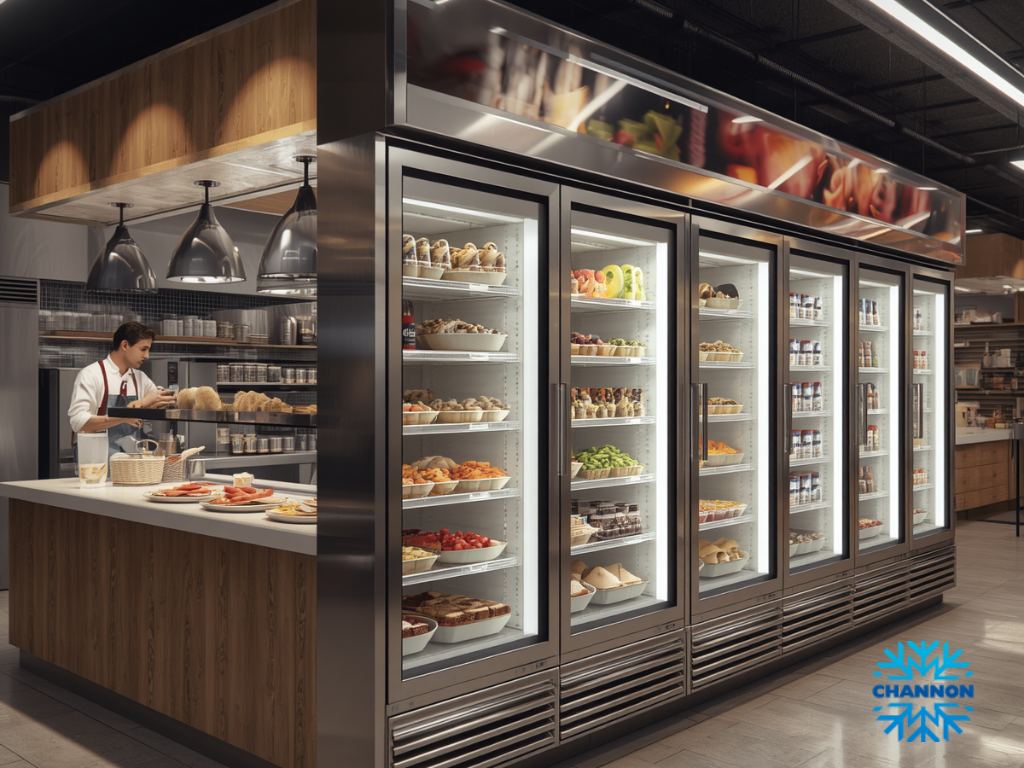
A glass-door refrigerator or refrigerated display cabinet may be appropriate when customers need to see the products being offered. Cafés, bakeries, convenience stores and takeaway businesses often use display refrigeration for drinks, cakes, sandwiches and other chilled products.
The Australian Energy Rating framework recognizes several different categories of commercial cabinets, including refrigerated storage cabinets, refrigerated display cabinets, refrigerated drinks cabinets and certain ice cream or scooping cabinets. This is another reason to compare products designed for the same purpose rather than treating every commercial refrigerator as equivalent.
If you are comparing commercial fridges Sydney suppliers offer, first decide what job the cabinet needs to perform. That will reduce the number of irrelevant options quickly.
Check Measurements Before You Order
A refrigerator can have the perfect capacity and still be completely unsuitable if it does not fit the premises.
Measure the intended installation area carefully.
Check the width, height and depth available, but do not stop there. You also need to consider how the doors open and whether staff can stand comfortably in front of the cabinet while retrieving stock.
An outward-opening door that blocks the main kitchen walkway can quickly become frustrating during busy service.
Measure the delivery route as well.
Large commercial refrigerators need to travel from the delivery vehicle to their final position. Doorways, corridors, lifts, stairways and tight corners can all become problems if equipment dimensions have not been checked beforehand.
Ventilation clearance is another important consideration.
Commercial refrigeration generates heat while removing heat from inside the cabinet. The exact clearance requirements depend on the model, so follow the manufacturer’s installation instructions rather than assuming the unit can be pushed tightly against walls or adjacent equipment.
Service access should also be planned from the beginning.
Compressors, condensers and other components may eventually require cleaning, inspection or repair. Installing a refrigerator in a position where those components cannot be reached can make routine maintenance unnecessarily difficult.
Power requirements need to be confirmed as well. Do not assume every piece of commercial refrigeration equipment can use any convenient existing outlet. Check the electrical specifications for the model before installation.
These practical details are particularly important when a new kitchen or hospitality fit-out is being planned. Changing the position of a refrigerator on a floor plan is simple. Changing electrical services, benches or fixed joinery after the kitchen has been completed is considerably more disruptive.
What Temperature Range and Capacity Should You Look For?
Choose Equipment for the Food You Need to Keep Cold
Not every commercial refrigerator is designed to do exactly the same job.
A chilled storage cabinet, freezer, beverage refrigerator and refrigerated display cabinet may operate differently and be designed for different products.
Start with the required storage condition.
For NSW food businesses, potentially hazardous cold food generally needs to be stored or displayed at 5°C or below. Food intended to remain frozen should remain frozen during storage and display.
The NSW Food Authority also requires food businesses handling potentially hazardous food to have access to an accurate probe-type thermometer so food temperatures can be checked when necessary.
That distinction is useful because the temperature shown on a refrigerator’s display does not always tell you the exact temperature of the food itself.
When comparing equipment, check the operating temperature range specified by the manufacturer and make sure it suits the intended products.
Also consider the environment in which the refrigerator will operate.
Commercial kitchens can become hot, particularly around ovens, fryers and other cooking equipment. A cabinet designed for one set of ambient conditions may not necessarily perform the same way when positioned in a much hotter environment.
This is why placement, equipment specification and kitchen layout should be considered together.
If you are uncertain whether a particular cabinet suits your products or operating environment, ask the supplier to explain the model’s intended use and operating specifications before purchase.
Avoid Both Overloading and over sizing
Choosing the right capacity means avoiding two opposite problems.
A refrigerator that is too small can quickly become overcrowded.
When staff struggle to find room for a delivery, products may be stacked poorly, difficult to rotate or positioned in ways that make organized storage harder.
A larger cabinet can solve capacity problems, but unnecessarily large refrigeration also has disadvantages.
It occupies more space, usually costs more to purchase and may use more energy than a smaller cabinet suitable for the same task.
Australia’s Energy Rating program advises buyers to consider whether new equipment has the right capacity and specifically notes that bigger is not always better when running costs are considered.
Capacity planning should therefore consider actual stock movement.
Work out how much refrigerated stock is normally held immediately after a delivery, because this is often when storage demand is highest.
Then consider how quickly that stock turns over.
A business receiving frequent deliveries may need less bulk storage than one that purchases several days of ingredients at once.
You can also divide storage across different work areas instead of relying on one oversize refrigerator.
For example, bulk stock may remain in upright refrigeration while frequently used ingredients are placed in a smaller under-bench cabinet near the preparation area.
This approach can improve workflow while keeping capacity matched to the way the business actually operates.
How Do Energy Use and Maintenance Affect Long-Term Cost?
The initial equipment price is easy to see, but it represents only part of what a commercial refrigerator costs the business over time.
Commercial refrigerated cabinets often operate continuously, which means electricity consumption matters.
Australia’s Energy Rating program describes commercial refrigerated cabinets as significant energy users and recommends looking at lifetime cost, including the purchase price, installation, maintenance and running costs.
Commercial refrigerated cabinets covered by Australia’s current Greenhouse and Energy Minimum Standards framework are subject to minimum energy performance requirements. However, unlike many household appliances, they are not required to display the familiar Energy Rating Label. Suppliers can voluntarily display an applicable star rating, and registered information can also be checked through the Energy Rating Product Database.
When comparing star ratings or energy information, make sure the products are genuinely comparable.
The Energy Rating program advises comparing cabinets of the same type, size and operating temperature rather than comparing very different refrigeration products purely by their rating.
Usage also affects real-world consumption.
A refrigerator opened constantly during lunch service has a different operating pattern from bulk-storage refrigeration accessed only occasionally.
Location can matter too. Equipment positioned in an excessively hot area or where required airflow is restricted may operate under more demanding conditions.
For businesses looking at commercial refrigeration sales Sydney options, asking for energy-performance information before purchase can therefore provide a more complete picture than comparing equipment prices alone.
Think About Cleaning, Servicing and Replacement Parts
Commercial refrigeration is working equipment, and maintenance should be considered before buying rather than only after something breaks.
Start with routine cleaning requirements.
Door seals should be kept clean and checked for deterioration. Interior shelves and surfaces need to be accessible for hygienic cleaning, while condenser maintenance should follow the manufacturer’s instructions.
A damaged door seal can allow cold air to escape and warm air to enter. Restricted airflow around refrigeration components can also make the system work harder.
The exact maintenance schedule will vary according to the equipment, operating conditions and manufacturer, so avoid relying on a single generic servicing interval for every refrigerator.
Instead, check the maintenance instructions supplied with the model and ask what servicing the supplier recommends for the intended commercial environment.
Warranty is another important buying consideration.
Find out how long the equipment is covered, what parts or labor are included and who performs warranty repairs in Sydney.
After-sales support becomes particularly important when refrigeration is essential to daily trade.
If a refrigerator containing a large amount of perishable stock develops a fault, access to technical support may matter more than a small difference in the original purchase price.
Check spare-parts availability as well, particularly for equipment you expect to keep for many years.
A commercial fridge should therefore be assessed as an ongoing operating asset rather than a one-off purchase.
Should You Buy, Lease or Rent a Commercial Fridge?

When Buying Commercial Refrigeration Makes Sense
Purchasing equipment outright can make sense for an established business that knows exactly what it needs and expects to use the refrigeration for a long period.
Ownership gives the business control over the asset, subject to warranty conditions and normal maintenance responsibilities.
It can be particularly practical when replacing an existing refrigerator with a suitable model and the kitchen layout, electrical supply and operating requirements are already known.
Businesses searching for commercial refrigeration equipment for sale should still avoid buying purely according to upfront price.
Compare the specification, capacity, temperature range, energy information, installation requirements, warranty and servicing.
It is also worth checking whether the equipment is properly registered where Australia’s GEMS requirements apply. Regulated commercial refrigerated cabinets fall under the Greenhouse and Energy Minimum Standards framework, and registered models can be viewed through the government’s Energy Rating database.
Used equipment requires additional care.
A second-hand refrigerator may offer a lower purchase price, but its condition, previous use, servicing history and remaining parts support may be less certain. Have important equipment assessed appropriately rather than assuming a cabinet is reliable because it becomes cold when switched on.
Buying usually makes the most sense when the business has a stable long-term need and is comfortable taking responsibility for the equipment throughout its useful life.
When Leasing or Renting May Offer More Flexibility
Buying is not the only option available to every hospitality business.
A commercial fridge lease may be worth considering where a business prefers to spread equipment costs over time rather than make a larger upfront purchase.
Rental can serve another purpose.
A commercial refrigerator for rent may be useful for temporary operations, events, short-term increases in demand, equipment replacement while another unit is unavailable or businesses that do not yet want to commit to ownership.
Some people search specifically for a commercial fridge on rent when they need temporary capacity rather than a permanent addition to the kitchen.
The important point is to compare the entire agreement rather than only the periodic payment.
Ask how long the agreement runs, what is included, who is responsible for servicing, what happens if the equipment fails and whether delivery, installation or collection are additional costs.
If the arrangement is a lease or finance agreement, understand what happens at the end of the term and whether ownership transfers.
Rental can offer flexibility, but a long rental period can have different financial implications from purchasing. Conversely, buying a refrigerator for a temporary requirement may leave the business with equipment it no longer needs.
The appropriate choice therefore depends on expected use, available capital, business plans and the terms offered by the supplier.
How Should You Compare Refrigeration Suppliers and Equipment Options?

Compare Specifications, Warranty and After-Sales Support
Once you know what type of refrigeration you need, supplier comparison becomes much easier.
Start with the actual equipment specification.
Check internal capacity, external dimensions, operating temperature range, door arrangement, shelving, power requirements and installation clearances.
Then look at warranty and after-sales support.
A good commercial refrigeration supplier should be able to explain what is covered by the manufacturer’s warranty and what happens if technical support is required.
Businesses researching commercial refrigeration sales Sydney should also consider whether the supplier provides installation and servicing rather than assuming equipment support ends when the sale is completed.
Channon is one Sydney-based supplier offering commercial refrigeration equipment across categories that currently include under-bench refrigeration, upright equipment, food displays, freezers and other hospitality refrigeration. Its website also states that it offers equipment for purchase or rental, along with refrigeration installation and technical servicing.
Whether comparing Channon with another supplier or reviewing several equipment brands, use the same criteria.
The right provider should help you understand which equipment suits the requirement rather than simply encouraging you to purchase the largest or most expensive option.
Clear specifications, realistic advice, warranty information and access to servicing are useful trust signals because they help the business understand what happens after installation as well as before it.
Choose Equipment That Fits the Whole Operation
The best commercial refrigerator is not necessarily the model with the most capacity or features.
It is the equipment that works properly within the wider operation.
Think about how staff move through the kitchen.
Refrigeration for frequently used ingredients should generally be convenient to the preparation area it supports. Bulk storage can often sit elsewhere because it is accessed less frequently.
Customer-facing refrigeration needs to work with the service counter and customer flow.
Delivery routes matter too. Staff should be able to move stock into cold storage efficiently when deliveries arrive rather than carrying chilled products unnecessarily through several work areas.
The rest of the kitchen also influences refrigeration selection.
Cooking equipment creates heat. Stainless-steel benches determine available under-counter space. Electrical services affect where equipment can be connected. Fixed counters can restrict access for installation and servicing.
If you are fitting out a new venue, these decisions should ideally be coordinated before equipment is ordered.
A refrigerator purchased independently because it appears to be a good deal can become an expensive problem if the cabinet does not fit the.