AI automation services are becoming an important consideration for Australian businesses looking to reduce repetitive work, improve information flow and make better use of their existing software. As artificial intelligence becomes more accessible, many business owners are asking whether they need an AI agent to manage everyday tasks.
The answer is not always yes.
An AI agent can be useful when a business process involves interpreting information, working across different systems and completing several connected steps. However, many tasks can be handled effectively by conventional automation, existing software features or simpler AI tools.
For example, a business that manually copies customer details from a website form into a CRM may only need a straightforward integration. An AI agent may introduce unnecessary complexity if the information is already structured and the required actions are predictable.
On the other hand, an organisation that receives different types of customer emails, needs to interpret requests and must retrieve information from several systems may have a more suitable application for an AI-assisted workflow.
The best starting point is understanding the business problem rather than choosing the technology first.
What AI Automation Services Actually Do for Businesses
AI automation services help businesses assess, design and implement processes that reduce manual work.
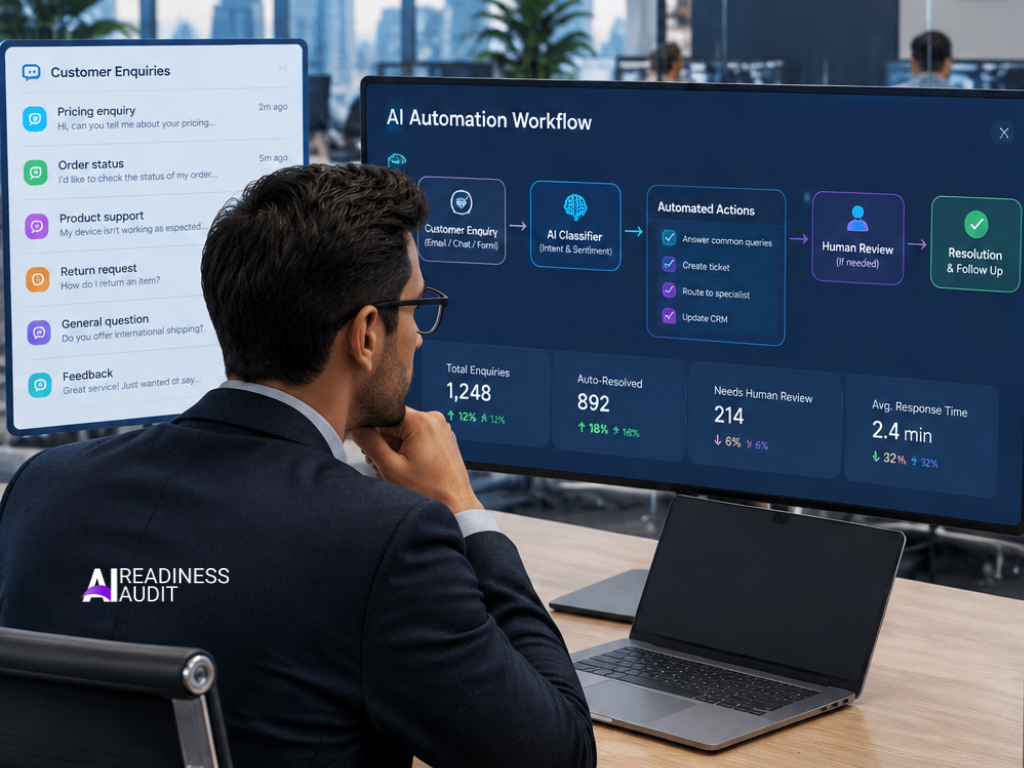
Depending on the requirements, these services may involve connecting existing applications, extracting information from documents, categorising customer enquiries, preparing responses or routing tasks to the appropriate employees.
Some solutions use conventional software automation with little or no artificial intelligence.
Others combine AI models with databases, business rules, APIs and approval processes.
For example, a professional services firm might receive enquiries through its website, email and customer management system.
A suitable automation could bring these enquiries into one workflow, record relevant details and notify the correct employee.
If incoming information is unstructured, artificial intelligence may help interpret its meaning before the workflow continues.
However, businesses should consider how the information will be checked and what happens when the system cannot confidently process a request.
Effective automation is not simply about removing human involvement. It is about reducing unnecessary work while keeping appropriate control over business decisions.
Why an AI Agent Is Not Always the Right Starting Point
An AI agent is generally designed to work towards a defined goal by interpreting information, selecting steps and interacting with approved tools or systems.
This can be valuable for complex processes, but the extra flexibility also introduces additional requirements.
An agent may need access to business records, permission to perform actions and safeguards to prevent incorrect changes.
It also requires testing, monitoring and a clear process for handling unexpected situations.
For a predictable task, such as sending a confirmation email after a form submission, conventional automation is often simpler.
Similarly, automatically creating a CRM record from structured form fields may not require an AI model.
An agent becomes more relevant when the workflow involves varying information, several possible paths or tasks that require interpretation.
Before investing in AI automation services, businesses should establish whether a simpler solution can meet the same objective with fewer costs and risks.
Understanding AI Agents, Chatbots and Workflow Automation
The terms AI agents, chatbots and workflow automation are sometimes used interchangeably, but they describe different capabilities.
Understanding these differences helps businesses compare solutions and avoid paying for technology that does not match their requirements.
When evaluating AI automation services, it is useful to examine what the system actually does rather than relying on the product name.
How AI Agents Differ From Traditional Automation
Traditional automation follows predefined instructions.
For example, a workflow might automatically send an email when a customer completes an enquiry form.
The process follows a known sequence with clearly defined conditions.
If the customer selects a particular service, the workflow can assign the enquiry to the relevant department.
This type of automation is useful when the rules are predictable and the input information is consistent.
AI agents work differently.
Depending on their design, they can interpret information, decide which approved tools to use and select actions intended to achieve a particular goal.
For example, an agent could examine an incoming email, determine whether it relates to an existing project, retrieve relevant records and prepare a response for review.
However, agents do not all have the same capabilities.
Some operate only within a narrow task, while others can interact with multiple connected systems.
Their permissions, accuracy and level of independence depend on how they are designed and configured.
Giving an agent more autonomy does not automatically make it more useful.
For many businesses, a controlled combination of AI interpretation and conventional workflow automation provides a more practical approach.
Chatbots, AI Assistants and Agents: What Changes?
Chatbots are commonly used to communicate with customers or employees through a conversational interface.
A basic chatbot may answer frequently asked questions using predefined responses.
More advanced chatbots can use artificial intelligence to understand questions and generate responses from approved information sources.
An AI assistant may help employees summarise documents, draft communications or retrieve relevant information.
An AI agent can go further by performing approved actions using connected tools.
For example, a customer-facing chatbot might explain how to request a quotation.
An AI assistant might prepare a quotation summary using supplied project information.
An appropriately configured AI agent might retrieve customer details, check relevant records and create a draft quotation for employee approval.
These capabilities can overlap, and not every product uses the terminology consistently.
The important distinction is whether the system only provides information or can also interact with business processes and perform actions.
For customer-facing applications, businesses should also consider transparency, accuracy and how customers can reach a person when necessary.
Which Business Tasks Actually Benefit From AI Agents?
Not every repetitive task requires an AI agent.
The most suitable opportunities usually involve processes where information arrives in different formats, employees must interpret its meaning or work moves between several business systems.
When considering AI automation services, businesses should look for recurring problems that have clear outcomes and can be managed within defined boundaries.
When AI Automation Can Handle Multi-Step Workflows
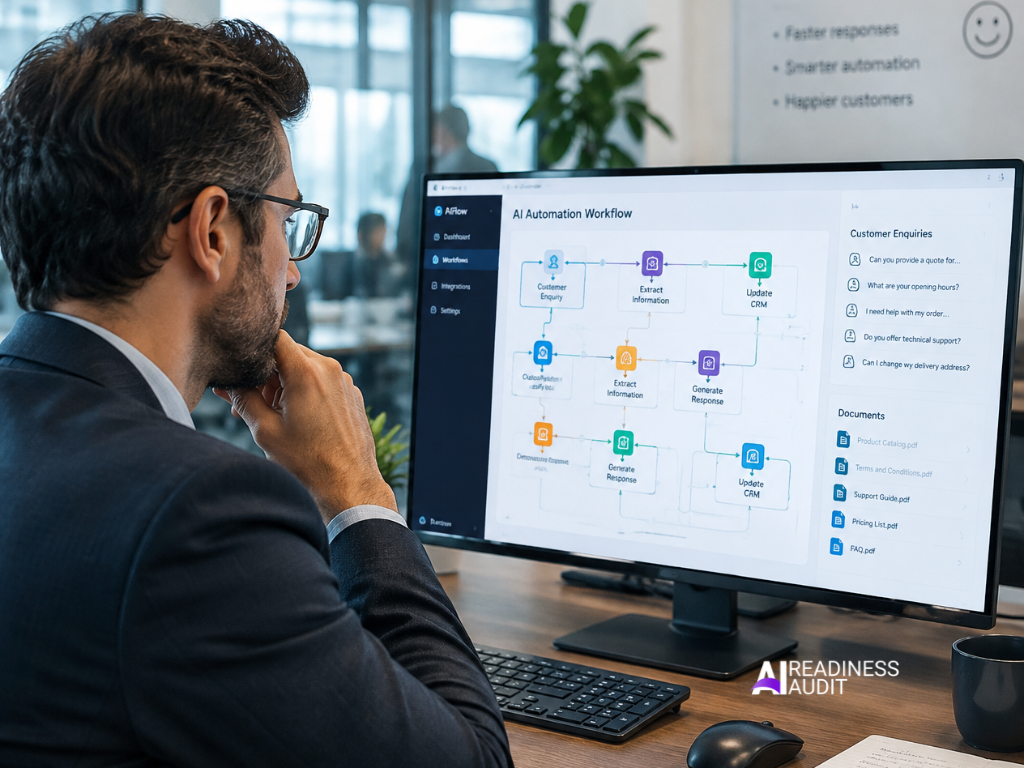
Consider a business receiving customer enquiries through emails, online forms and attached documents.
An employee may need to read the information, identify the requested service, check whether the customer already exists in the CRM and forward the enquiry to the appropriate person.
If the information is consistent and follows a standard format, conventional automation may be enough.
However, when enquiries contain free-form descriptions, different document types or incomplete details, AI may help interpret the information.
An AI-assisted process could extract relevant fields, identify missing information and prepare a structured summary.
A connected workflow could then create a draft CRM record or assign the enquiry for review.
Another practical application involves document processing.
A business receiving supplier invoices might use AI to extract invoice numbers, dates, line items and amounts from documents with different layouts.
The extracted information could be checked against existing records before an authorised employee approves further processing.
These examples do not require an agent to make unrestricted decisions.
Instead, AI can assist with interpreting information while business rules and human approvals control subsequent actions.
This approach can be particularly useful for Australian service businesses, construction companies, retailers and professional firms managing recurring administrative work.
Where Predictive Analytics and Human Decisions Fit
Predictive analytics is another application of artificial intelligence, but it is not the same as an AI agent.
Predictive analytics uses historical information and statistical or machine learning techniques to estimate possible outcomes.
For example, a retailer may analyse previous sales patterns to support inventory planning.
A service business might examine historical enquiry information to understand demand patterns.
However, predictions depend on the quality, relevance and limitations of the underlying data.
An organisation should not assume that an AI-generated forecast will be accurate simply because advanced technology was used.
An AI agent might retrieve or present predictive information as part of a workflow, but it does not automatically possess reliable forecasting capabilities.
Human decision-making remains important, particularly when predictions could affect customers, employees or financial commitments.
For example, an automated system may recommend reviewing stock levels, but a purchasing decision might still require an employee to consider supplier availability, seasonal conditions and business priorities.
The right combination of predictive analytics, automation and human review depends on the consequences of the decision.
Choosing Between an AI Platform and Custom Development
Once a business identifies a suitable workflow, the next decision is how to implement it.
Some organisations can use existing software features or a ready-made AI automation platform.
Others may need additional integrations or custom AI development to support specialised operations.
The right approach depends on the systems already in place, the complexity of the workflow and the level of control required.
When an Existing AI Automation Platform Is Enough
Many business applications already include automation features.
CRM systems, accounting platforms, project management tools and customer support applications may provide ways to trigger actions and transfer information.
Some also include AI-assisted functions for summarising information, categorising records or preparing communications.
These capabilities should be assessed before introducing another application.
For example, a company that wants customer enquiries automatically assigned to staff may already have suitable workflow rules within its CRM.
Adding an AI agent could increase cost and maintenance without improving the process.
An existing AI automation platform may be appropriate when the required integrations are supported and the workflow can operate within its available controls.
However, businesses should check how the platform handles data access, exceptions, usage charges and ongoing support.
It is also important to understand what happens when an integration fails or information does not match the expected format.
A useful platform should make the process easier to manage, not create another system that employees must constantly supervise.
When Custom AI Development May Be Worth Considering
Custom AI development becomes more relevant when existing tools cannot adequately support a business’s requirements.
For example, an organisation may use a specialised internal database that does not connect easily with standard automation platforms.
Another business may need to combine information from several systems while applying detailed rules about permissions and approvals.
Custom development can provide greater flexibility in designing these interactions.
However, flexibility comes with responsibilities.
The organisation must consider development costs, software maintenance, security testing, documentation and future changes to connected systems.
A custom solution may also involve ongoing charges for AI models, hosting, integrations and technical support.
Before investing, businesses should determine whether a simpler configuration or targeted integration could achieve the desired result.
In some cases, a combination of existing software and a small custom component may be more practical than developing an entirely new platform.
The decision should be based on business requirements and long-term maintainability rather than the assumption that custom technology is inherently better.
Understanding Costs, Risks and Ongoing Responsibilities

AI automation services involve more than purchasing software or connecting an AI model to a business application.
Implementation also requires workflow design, data preparation, testing and ongoing management.
These considerations become more important when an AI agent can access sensitive information or perform actions within operational systems.
What Determines the Cost of AI Agent Implementation?
The cost of implementing an AI agent depends on several factors.
A narrowly defined process using existing integrations may require less development than a system connected to multiple databases and specialised applications.
The condition of the business’s existing data also matters.
If customer records are inconsistent, documents are poorly organised or important information is missing, preparation may be required before automation can operate reliably.
Other considerations include the number of users, expected processing volume, security requirements and the level of testing needed.
Costs may include software subscriptions, API usage, implementation work, hosting and ongoing monitoring.
Staff training and maintenance should also be considered.
For example, a workflow that changes frequently may require additional updates to remain useful.
Businesses should therefore compare the total cost of ownership rather than focus only on the initial development fee.
A useful starting point is to measure the existing process.
Understanding how long tasks take, how frequently exceptions occur and what the current process costs provides a basis for evaluating whether automation is worthwhile.
Managing Data Privacy, Accuracy and Human Oversight
AI agents can introduce additional risks because they may access business information and interact with connected systems.
If an agent is given permission to update customer records, send messages or perform other actions, those permissions need to be carefully controlled.
Businesses should determine what information the system can access and which actions require approval.
Personal information and commercially sensitive records also need appropriate protection.
Australian privacy obligations depend on the organisation and the information involved, so businesses should review the requirements that apply to their operations.
AI outputs can also be incorrect.
An agent may misunderstand an instruction, retrieve irrelevant information or prepare an inaccurate response.
For this reason, organisations should test how the system handles incomplete information, unexpected requests and conflicting instructions.
Human review is particularly important for sensitive communications, financial decisions and actions that could significantly affect customers or employees.
The Australian Cyber Security Centre’s guidance on the careful adoption of agentic AI recommends limiting initial use to well-defined, low-risk tasks and applying appropriate access controls, monitoring and human oversight.
These principles reinforce the importance of introducing AI gradually rather than granting broad access from the beginning.
How to Compare AI Automation Providers in Australia
Choosing an implementation partner involves more than reviewing software demonstrations.
Businesses need to understand whether a provider can assess existing processes, explain the available options and design a solution that fits operational requirements.
When comparing AI automation services, look for a clear approach to business analysis, integration, security and ongoing support.
Questions to Ask AI Automation Companies Before Hiring
A useful provider should begin by understanding the workflow that needs improvement.
This includes identifying which employees are involved, what information is required and how the process currently works.
Ask whether the proposed solution genuinely needs an AI agent or whether existing automation features could achieve the same result.
The provider should be able to explain which systems need connecting and what permissions will be required.
Pricing should also be transparent.
Businesses need to understand what is included in the initial implementation and which costs continue after deployment.
These may involve subscriptions, AI usage, technical support and future modifications.
Ownership and access arrangements are equally important.
For example, a business should understand who controls its data, integrations, software accounts and system documentation.
It is also useful to ask how the provider tests unusual situations and what happens when the automation cannot complete a task.
Comparing AI automation companies on these practical considerations provides more useful information than relying on general claims about advanced technology.
Why Workflow Assessments and Testing Matter
An effective AI project begins with understanding the current process.
A workflow assessment can identify repeated tasks, disconnected systems, manual data handling and areas where errors or delays occur.
It can also reveal problems that AI will not solve.
For example, if a business has unclear approval responsibilities or inconsistent customer records, automating the process without addressing those issues may create new difficulties.
AI Readiness Audit offers structured assessments for organisations considering artificial intelligence adoption.
Its published services include reviewing business systems, data, workflows, governance and team capability to identify gaps and opportunities before investment.
The business also offers AI maturity assessments for organisations already experimenting with AI, along with AI consulting, automation and custom development services.
These assessments can help businesses establish whether an AI agent is suitable or whether improvements to existing workflows should come first.
Readers can explore the AI Readiness Audit website to understand the available assessment and planning services.
Before implementing a larger solution, testing a limited workflow can provide useful evidence.
A practical pilot should have defined inputs, expected outputs, measurable success criteria and a process for reviewing mistakes.
This helps businesses understand whether the proposed automation works under realistic conditions before expanding its responsibilities.
Deciding Whether Your Business Is Ready for an AI Agent

The decision to adopt an AI agent should be based on a clear business need.
An organisation may benefit from AI automation services without requiring an autonomous system.
In some cases, improving a workflow or connecting existing applications may provide a more straightforward solution.
The goal is to choose technology that supports the business rather than introduce complexity for its own sake.
How to Evaluate Your Need for AI Automation Services
Start by examining the work your team performs regularly.
Consider where employees spend time transferring information, reviewing documents, responding to enquiries or checking records across multiple systems.
The next step is understanding why the work takes time.
If the process is repetitive and follows clear rules, conventional automation may be appropriate.
If employees must interpret varied information or determine which steps are needed, AI-assisted processing may offer additional value.
An AI agent becomes more relevant when a workflow involves several connected actions that cannot be handled effectively through predefined rules alone.
However, the system should still operate within clear boundaries.
Businesses need reliable information sources, suitable access permissions and a process for handling errors.
Employee involvement is also important because the people completing a task often understand its exceptions better than those designing the automation.
Before making an investment, determine what the system should achieve and which responsibilities must remain with employees.
Starting With a Practical AI Project You Can Measure
A manageable first project is usually more useful than attempting to automate an entire business operation immediately.
For example, a service business might begin by improving how incoming enquiries are categorized and assigned.
An accounting team might test document extraction before introducing more complex approval workflows.
A professional services firm might evaluate AI-assisted document summaries while keeping final review with qualified employees.
The project should have a clear starting point, a defined outcome and appropriate safeguards.
Businesses can measure whether the process reduces manual handling, improves information completeness or makes work easier to manage.
Results should be compared with the previous workflow rather than assumed.
If the system performs reliably and delivers useful outcomes, the business can consider expanding its responsibilities.
If it struggles with exceptions or requires constant correction, the workflow may need further improvement before scaling.
For organisations unsure where to begin, an AI readiness assessment can help identify which systems, processes and data need attention before implementation.
An AI agent may be appropriate for some business tasks, but it is not the answer to every automation problem.
A successful approach starts with understanding the work, selecting the simplest suitable solution and introducing more advanced capabilities only when there is a clear reason to do so.
By comparing AI agents, chatbots, workflow automation and custom development against their actual requirements, Australian businesses can make more informed decisions about AI investment and build a stronger foundation for future automation.