
Sustainability reporting software can help organisations do more than assemble figures for an ESG or climate disclosure. It can also help maintain the evidence behind those figures, including source records, methodologies, assumptions, supporting documents, reviews and approvals.
For Australian businesses, this is increasingly important as sustainability reporting moves into a more formal reporting and assurance environment. AASB S2 requires applicable entities to disclose climate-related information across governance, strategy, risk management, metrics and targets, while also addressing areas such as judgements, uncertainties and greenhouse gas measurement approaches. ASIC has also identified sustainability reporting and assurance as an ongoing regulatory focus for 2026–27.
Good reporting therefore depends on more than having a final number. Businesses need to be able to understand how important information was produced, what it was based on and whether there is sufficient supporting evidence behind it.
Why ESG Evidence Matters in Sustainability Reporting
Sustainability reporting software can provide a structured way to connect ESG and climate disclosures with the information used to prepare them. This matters because the reliability of a disclosure often depends on the quality of the records sitting behind it.
How sustainability reporting software connects disclosures with supporting evidence
A sustainability report may contain emissions figures, climate risks, environmental performance measures and other statements that appear straightforward when presented in the final document. Behind those disclosures, however, there can be invoices, spreadsheets, supplier information, calculations, methodologies, management estimates and supporting documentation.
If those records are stored across emails, shared drives and separate systems, finding the basis for a reported figure later can become difficult.
sustainability reporting software can help organisations maintain clearer relationships between a disclosure and its underlying information. For example, an emissions figure may be connected with the source data, reporting period, methodology, relevant assumptions and supporting documentation used to prepare it.
This does not automatically prove the information is correct. What it provides is a clearer evidence trail that allows teams to understand how the disclosure was developed.
That becomes particularly useful when information needs to be reviewed internally, explained to management or prepared for external assurance.
How sustainability reporting software supports stronger ESG compliance
ESG compliance is not simply a matter of completing a report by a deadline. Organisations also need processes for maintaining sustainability records that support the information being disclosed.
Under Australia’s sustainability reporting framework, entities required to prepare sustainability reports must obtain the applicable review or audit in accordance with the Corporations Act and relevant assurance standards. ASIC’s guidance also refers to the need for sustainability records sufficient to enable the report to be prepared and assured as required.
Sustainability reporting software can support this process by helping teams retain source information, ownership details, supporting evidence and review status.
The software itself does not create compliance. Legal obligations still need to be assessed against the organisation’s circumstances, and professional judgement remains necessary.
What a structured system can do is reduce uncertainty about where information came from and whether the records needed to support it are available.
Building Clear Source Records for ESG Information
Sustainability reporting software becomes particularly valuable when ESG information originates from many different parts of the organisation or value chain. Without clear source records, sustainability teams can end up working with figures that have lost their original context.
How sustainability reporting software records the source of ESG data
Environmental and climate information rarely comes from one system.
Electricity consumption might come from utility accounts. Fuel data may come from operations. Supplier information could arrive through procurement. Financial assumptions may originate with finance, while facility information may sit with asset or property teams.
Sustainability reporting software can help maintain these different records while showing where each important piece of information originated.
This source context matters because two figures that appear identical may have been produced very differently. One may be based on primary information while another relies on an estimate. One may cover a complete reporting period while another contains a data gap that required an assumption.
Keeping the source attached to the information makes those differences easier to recognise.
AASB S2 also requires applicable entities to provide connected climate-related information and, to the extent possible, use data and assumptions that are consistent with corresponding information used in their financial statements.
Clear source records can help reporting teams understand those connections.
How sustainability reporting software improves information provenance
Information provenance is essentially the history behind a record.
It answers practical questions such as where the information came from, when it was added, whether it changed, who reviewed it and what evidence supports its current use.
Sustainability reporting software can help retain this context rather than treating sustainability information as a collection of isolated values.
For example, if a supplier updates environmental information, teams should ideally be able to see that a previous record existed, when the change occurred and which version is currently being used.
This does not mean every organisation needs an overly complex approval process. The level of governance should reflect the importance of the information and the organisation’s reporting requirements.
The aim is to make trusted information easier to understand, not simply to create more administration.
Managing Methodologies, Assumptions and Calculations
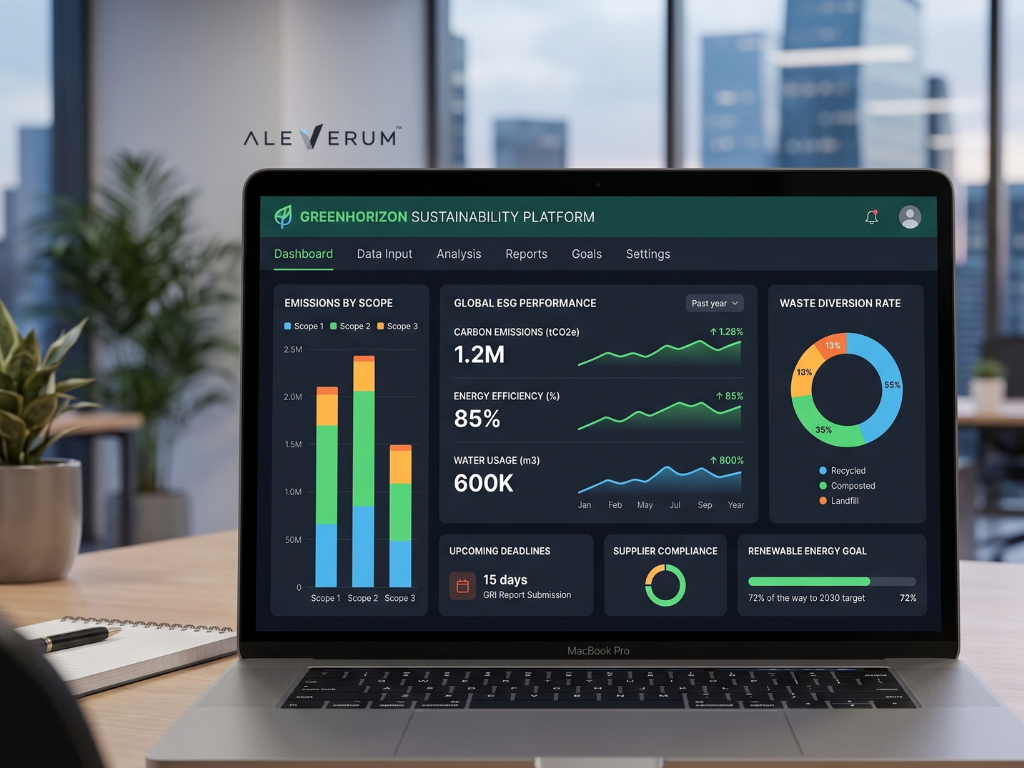
Sustainability reporting software should also help businesses maintain the reasoning behind important reported information. This is particularly relevant where sustainability disclosures rely on estimates, methodologies or assumptions rather than directly measured values.
How sustainability reporting software documents reporting methodologies
A reported figure is much more useful when the organisation can explain how it was produced.
For climate reporting, this may involve identifying the measurement approach, data sources, reporting boundaries, emission factors and assumptions used.
AASB S2 specifically requires applicable entities to disclose information about their measurement approach, inputs and assumptions when reporting greenhouse gas emissions. The standard also addresses measurement uncertainty and changes to assumptions.
Sustainability reporting software can help businesses keep these methodologies connected with the relevant data and reporting period.
This can become particularly important when an approach changes from one year to the next. Rather than simply replacing a methodology document, the organisation can retain a record of what was previously used and why the current approach differs.
That history gives reviewers better context and helps reduce the risk of relying on undocumented calculations.
How sustainability reporting software supports corporate carbon footprint evidence
A corporate carbon footprint may depend on information collected from several internal and external sources.
Scope 1 information may involve fuel use or other direct emissions. Scope 2 can involve purchased electricity and relevant contractual instruments. Scope 3 may depend on information from suppliers and other parts of the value chain.
Sustainability reporting software can help organise the evidence behind these figures by connecting emissions information with source data, methodologies, emission factors and relevant supporting records.
It is important to distinguish this capability from carbon accounting.
Some platforms are designed to calculate emissions, while others focus on governing the information used in carbon reporting. A sustainability reporting platform may provide strong evidence management without automatically calculating the complete corporate carbon footprint.
Businesses comparing products should therefore understand whether they need calculation capability, evidence governance or both.
Controlling Reviews, Approvals and Version History
Sustainability reporting software can also improve the way information moves through internal review. This becomes more important as sustainability reporting involves finance, sustainability, risk, operations and senior management rather than a single ESG team.
How sustainability reporting software manages ESG reviews and approvals
Important sustainability information may pass through several people before it appears in a final report.
An operational team may provide the original information, a sustainability specialist may review it, finance may check its relationship with financial reporting and management may eventually approve the disclosure.
Without a clear process, it can be difficult to determine whether a figure is still being prepared, has been reviewed or is ready for reporting.
Sustainability reporting software can help provide clearer status and responsibility around this process.
The objective is not necessarily to introduce complicated workflows. It is to make responsibility visible so people understand who provided information, who reviewed it and whether additional action is required.
This can be especially useful when reporting involves significant judgement or uncertainty.
ASIC’s current sustainability reporting activities include an ongoing focus on reporting quality and assurance as organisations implement the Australian framework.
Having clearer internal review processes can help businesses prepare information more systematically before it reaches that stage.
How sustainability reporting software reduces version-control problems
Version control can become a significant issue when sustainability information is managed through spreadsheets and shared files.
A calculation may be updated but an older copy could still be attached to an email. A methodology may change without the supporting notes being updated. Different departments may hold separate versions of the same environmental figure.
Sustainability reporting software can help maintain a more controlled record of changes.
Teams can see which information is current, which record has been superseded and when an update occurred.
This is especially useful when assumptions change. Instead of losing the history behind a figure, the organisation can retain the previous version and the context for the revision.
Better version control does not make the data inherently more accurate, but it reduces confusion about which information should currently be used.
Supporting CSRD and International ESG Requirements

For businesses operating internationally, sustainability reporting software can also help maintain evidence that may be relevant to different reporting regimes. However, organisations should avoid assuming that every international framework applies to them.
How sustainability reporting software can support CSRD compliance evidence
Australian businesses with European operations, subsidiaries or other relevant connections may encounter CSRD compliance requirements or requests for sustainability information from organisations within European supply chains.
Where these obligations apply, evidence management becomes important because sustainability disclosures can draw on information about environmental impacts, risks, policies, targets and performance.
The European reporting environment has also continued to change. In July 2026, the European Commission adopted revised European Sustainability Reporting Standards as part of reforms intended to simplify reporting and reduce the number of companies within CSRD scope.
This makes it important for businesses to confirm the current requirements that apply to them rather than relying on older guidance about the Omnibus ESG reforms or previous CSRD scope.
Sustainability reporting software can support this environment by maintaining the underlying information independently of one particular reporting template.
That can make records easier to reuse where the same evidence is relevant to more than one legitimate reporting purpose.
How sustainability reporting software organises CSRD IRO information
CSRD IRO refers to impacts, risks and opportunities considered as part of sustainability assessment and reporting processes.
These assessments can depend on a mixture of internal information, supplier records, operational data, environmental evidence and management judgement.
Sustainability reporting software can help organise that supporting information so teams can see what evidence contributed to the assessment.
For example, an environmental risk may be connected with a particular facility, supplier or operational activity, along with the information used to assess it.
The system does not determine which impacts, risks or opportunities are material. Materiality still requires appropriate analysis and judgement.
Its role is to provide a clearer evidence foundation so the reasoning behind assessments is easier to follow.
Choosing Sustainability Reporting Software for Evidence Management
Choosing sustainability reporting software requires more than looking at dashboards and reporting templates. Businesses should consider how the system manages the records that sit underneath the final report.
What to look for when choosing sustainability reporting software
A useful platform should make it possible to understand both the reported information and its context.
When comparing systems, consider whether supporting evidence can be connected directly with relevant records, whether source information is retained and whether changes can be tracked over time.
It is also worth reviewing how the platform handles responsibilities, access permissions, methodologies, approvals and integration with existing enterprise systems.
Data portability matters as well. Sustainability information may need to be used by other systems, auditors, reporting teams or future platforms, so businesses should understand how information can be exported and transferred.
Another important question is how the software handles missing or uncertain information.
A useful system should make data gaps visible. It should not create the impression that incomplete information has somehow become reliable simply because it has been entered into software.
How sustainability reporting software compares with broader ESG platforms
Sustainability reporting software, environmental social and governance software, carbon accounting tools and document-management platforms may overlap, but they are not necessarily interchangeable.
A carbon accounting system may have strong emissions-calculation capabilities but limited product or supplier evidence governance. A document-management tool may store certificates effectively but provide little connection between those documents and specific ESG disclosures.
A broader ESG system may provide reporting workflows but may not offer the level of information provenance required by a business with complex supplier, product or asset records.
Aleverum™ provides a governed information approach that can connect source records, supporting evidence and Data Pedigree across product, asset, supplier and environmental information.
For businesses comparing Aleverum™ with other sustainability reporting software, the useful question is not which platform has the longest feature list. It is whether the system can maintain the relationships between information, evidence, methodology, version and approved use that the organisation actually needs.
Creating a Stronger Evidence Foundation for Future Reporting

Sustainability reporting software is most useful when ESG evidence is managed continuously rather than assembled only when a report, customer request or assurance process begins.
How sustainability reporting software supports reliable environmental sustainability records
environmental sustainability information changes over time.
New supplier records may arrive. Energy information can be updated monthly. Methodologies can change. Certificates expire. Better-quality information may replace estimates previously used.
If evidence is maintained only once a year, teams can spend substantial effort reconstructing what happened during the reporting period.
Sustainability reporting software can provide a more continuous approach by maintaining source information and its supporting context as records change.
This also helps organisations reuse information more carefully.
A source record that supports one disclosure may potentially be relevant elsewhere, but the business can still check whether the context, reporting period and methodology are appropriate before using it again.
That is more reliable than repeatedly copying values between spreadsheets without preserving their origin.
How sustainability reporting software prepares ESG information for review
The strongest sustainability reporting process is one where an organisation can move from a reported statement back through the reasoning and evidence that supports it.
For businesses subject to Australia’s sustainability reporting regime, review and audit requirements are being phased in, and ASIC’s guidance makes clear that required sustainability reports must obtain the applicable assurance under the Corporations Act.
Sustainability reporting software can help prepare for that process by making evidence easier to locate, methodologies easier to understand and changes easier to trace.
It cannot guarantee that a disclosure will satisfy an auditor or regulator, and it does not replace appropriate professional advice.
What it can provide is a more organised foundation.
A practical first step is to take one important ESG or climate disclosure and work backwards. Identify the source information, methodology, assumptions, supporting evidence, reviewer and current approved version. If completing that exercise requires searching through multiple spreadsheets, inboxes and shared folders, there may be an opportunity to improve the way evidence is governed.
For organisations reviewing how sustainability evidence is collected, connected and maintained, Aleverum™ can support a structured approach to trusted digital information and Data Pedigree across environmental, supplier, product and enterprise records.